Dungeons & Dragons has enjoyed a resurgence into the late 2010s that has continued well into the 2020s. RPGs are cool now, apparently, thanks to shows like Stranger Things and Community, both famously about cool people.
However, that doesn’t mean everyone has an easy time finding a group to play Dungeons & Dragons in their area. It’s an undeniably social game that requires 3-7 (please don’t go any higher) people to enjoy.
This can be a tall order, particularly for some would-be Dungeons & Dragons fans who leave in areas with sparse nerd populations.
It doesn’t have to be doom and gloom, however. It’s often not that difficult to find a D&D 5e group (other TTRPGs may be a little harder), with a few good ways to go about it.
Make Your Own Dungeons & Dragons Group
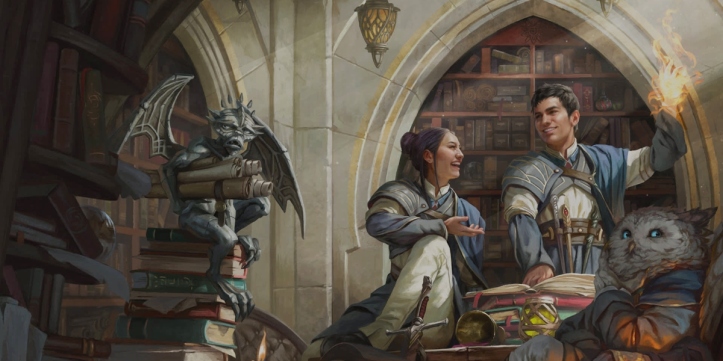
No, this isn’t me being glib. One of the best ways to start playing Dungeons & Dragons is to be the change you want to see in the world. Make a group by inviting your friends, family, and rivals with sexual tension to play with you.
This can, admittedly, be nerve-wracking. Many people might not know how to approach their loved ones about trying out the game. However, almost everyone has heard of D&D in this day and age.
More people than you think are curious about trying. If they say no, it’s not the end of the world. If they say yes, you have a fantastic new way to spend time with them.
Pros of Making Your Own D&D Group
Starting your own D&D group with people you already know has some advantages. You don’t need to try and make the best first impression you can while struggling to learn a new game. You can ease yourself in with people who like and accept you.
Furthermore, everyone is on the same page. You don’t need to worry about holding a group back if you’re inexperienced with D&D (although, I cannot emphasise this enough: most groups are very welcoming of new players). You can all learn together if you don’t know.
If everyone really gets into the Dungeons & Dragons game, you can even split the costs of things like books and dice to avoid one person being out of pocket.
Another benefit: You now have an incredible source of birthday and Christmas gift ideas for your group.
Cons of Making Your Own D&D Group
You might live in an area where nobody is interested. If you’re really unlucky, the people around you might even be hostile to Dungeons & Dragons. Thankfully, these attitudes are far less prevalent than they were in the 90s.
The person forming a new D&D 5e group often ends up being the Dungeon Master, due to the leaderly nature and extra work of that role. This can be very rewarding, but some players might want to dip their toes in as a player first (or simply dislike DMing).
Furthermore, there are costs to starting a game without the benefit of another group’s resources. You can mitigate this with things like the free D&D 5e Basic Rules (they’re remarkably comprehensive) and online dice rollers, but you will eventually need to put money down.
Attend Events at Your Local Game Store

If you live in any sort of urban (or maybe even suburban) area, there will almost certainly be an FLGS (Friendly Local Game Store) somewhere near you. This might be part of a chain (such as the UK-based Geek Retreat) or an independent shop.
Many local game stores hold D&D 5e events, seeing as the game is a significant money-spinner for the entire industry. These might be one-off events or they might be recurring, weekly games the public can attend.
Dungeons & Dragons has officially sanctioned public play in the D&D 5e Adventurer’s League, but there are many public games with a less formal nature.
It’s easy to poke your nose into your local geek shop and ask if they run any D&D 5e nights you can be a part of. If you do it in Birmingham, England, you might even find me running it.
Pros of Attending a Game Store D&D Night
You get to meet new people. This can be especially invaluable for those lacking friends in their area (such as new arrivals in a city) or those who aren’t as hot in social situations. A lot of people go to these D&D events looking to meet friends as well as play.
Usually, the game already has a DM. If you want to learn to play, or even if you just prefer that side of the table, you’ll rarely be expected to pull up a D&D Dungeon Master’s chair at your local nerd store.
Particularly popular shops often have games to match different skill levels. Often, there will be game nights for Dungeons & Dragons beginners and a more general game for all audiences.
Furthermore, you’re supporting a local business. Obviously, D&D is run from the tower of Wizards of the Coast, but you still give money back to small shops (that often need the custom!) while having fun at the same time. Lucky you.
Another excellent pro is the sheer number of resources the average FLGS has for players. They usually have store books, dice, and character sheets for players to use. Some even have miniatures and maps for cinematic D&D 5e combat.
Cons of Attending a Game Store D&D Night
It can be legitimately stressful to meet many new people at a time. Dungeons & Dragons is a hobby popular with people who can struggle in social situations. There’s no shame if meeting an entire table of D&D players for the first time is nerve-wracking.
These events usually cost money. The first one might be free, but the shop needs to keep the lights on somehow. This may be a direct entry fee or an expectation to buy food and drink during the session. Particularly with the current state of everything, this may be one expense too many.
You can’t always know who will be at the table. Most Dungeons & Dragons events in public shops have rules regulating conduct between players and removing problem individuals. However, there is still a risk of a bad experience from people who make the game worse.
Not everyone has a Dungeons & Dragons shop near them. People in big cities have better access than those in smaller towns, but it won’t always be convenient. Going to a Dungeons & Dragons night in your town may involve a commute.
Check Out Your Local Community Centre

Not all towns are sociable or well-off enough to have community centres (or other similar services like youth or church groups). However, these places often run Dungeons & Dragons games (or similar) due to their relative cheapness and social nature.
It’s a gamble whether your local community centre (if you have one) has anything tabletop game in nature. However, you never know until you ask.
If it does, you can join a ready-made Dungeons & Dragons group. Players might be passionate about the game or just starting out, but either way, they’re likely to be good people to start the game with.
In a way, this can split the difference between a Dungeons & Dragons home game and a paid store event. It will be less commercialized, but still with strangers.
Pros of a Community Centre D&D Group
Many community centre events are free. They’re there for people to get more involved and meet those around them. You’re likely to not have to pay for your Dungeons & Dragons game.
Similar to a game store, many of these games already have Dungeon Masters running them and are ideal for new players.
Cons of a Community Centre D&D Group
They’re very situational. Not everyone has a nearby community centre. Many community centres lack a D&D group or anything similar (the events really are a roll of the dice). Tabletop games are becoming more common, however, particularly in youth clubs.
Much like a game store, you can’t control who else sits down at the table. Most people will be kind, friendly, and pro-social. However, some Dungeons & Dragons players can do their best to sour the experience.
Go Online with a Digital Service

The future is now, and Dungeons & Dragons doesn’t have to be played in person. There is something fantastic about the atmosphere around a table, but it’s far from the only way to play.
Online Dungeons & Dragons games are blossoming, particularly with several high-profile digital clients for players to use.
Roll20.net is the most famous and popular, having seen an immense boom during the COVID-19 pandemic. Players can use it to find a public Dungeons & Dragons game (or, indeed, almost any other tabletop RPG) to enjoy.
Other websites like StartPlaying for similar purposes. Not just letting players enjoy Dungeons & Dragons digitally, but also to help connect players with groups.
Often, these digital tabletops provide things like virtual dice, maps, and tokens to bring the D&D 5e game to life. At the bare minimum, they provide a group and a way to communicate with them to make magic.
Pros of Playing D&D Online
It is massively convenient. It’s a Dungeons & Dragons game where you don’t need to leave the house, drive anywhere, or even put on trousers (con: You can’t be sure everyone else is wearing trousers). It can fit into almost any schedule.
The number of players and groups on Dungeons & Dragons sites like Roll20 dwarfs (ha) what you’ll find in your local community. The internet is a vast place, and it’s kind of full of nerds.
Many DMs on Roll20 advertise for groups of specific experience levels. There are many Dungeons & Dragons beginner games online and others for players with more time in the game. You can find something that suits you.
You get to meet people you’d never meet otherwise. With how horrible the internet is, it’s easy to forget it can genuinely bring people together. You’re unlikely to meet a D&D player from the other side of the planet down your local game store.
You also get far more choice than you would in most other D&D 5e environments. You can screen games for system, skill level, availability, setting, LGBT+ friendly, etc.
Cons of Playing D&D Online
It can lose something compared to playing in person. Playing Dungeons & Dragons over the internet remains a fantastic way to enjoy the game. However, many players prefer talking to other people in the flesh while they play, rather than it feeling like another video game.
The usual dangers of the internet apply. You can’t be sure who you’re speaking to, even with things like cameras and microphones. Sites like Roll20 are a fantastic way to make friends, but people have to take care of their own safety.
Online D&D games don’t work for everyone. People with poor infrastructure or internet may well find they can’t play in this way.
It’s far more acceptable for Dungeons & Dragons DMs to have an application process or screening system online than in real life (due to the number of people if nothing else). This might feel too much like a chore for some.
Search on Reddit and Other Forums/Social Media
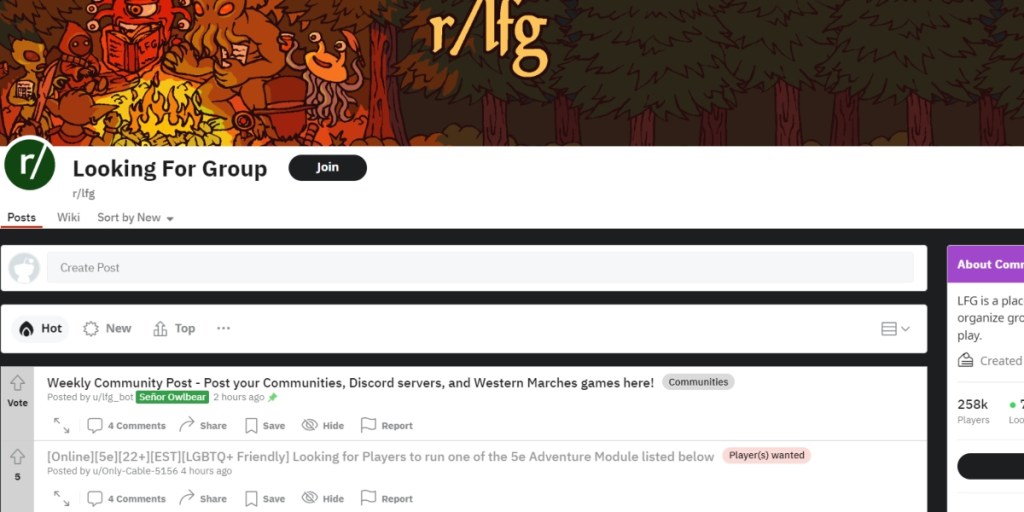
Roll20.net and its ilk are not the only way to find Dungeons & Dragons games online. The regular way of communicating with your fellow man also works.
Reddit is a particularly good website. It has a massive tabletop gaming community, including the dedicated /r/lfg subreddit that exists for this very purpose.
Dungeons & Dragons fans can post either as players looking for a group/DM to accommodate them or as a DM looking for players. These games might be in-person (obviously, geography-limited) or through online means like Roll20 or Discord.
Reddit isn’t the only platform. Twitter (I’m not calling it X), Facebook, Instagram, Discord, and basically any other website where you can talk to people can work. This might involve looking at specific communities or hashtags, or screaming “Can I play D&D with you?” into the void and seeing if the void responds.
Pros of Looking for a D&D Game Online
This can combine the best bits of online play and searching in person. You can find local games being advertised online, while still having access to vastly more people than you would normally. If you want to play in meatspace but are finding dead ends, /r/lfg might save your life.
Like with Roll20, you can pick and choose from games. Many groups give short descriptions of their Dungeons & Dragons game or who they’re looking for, giving you an idea of what to expect. If you’re a player searching for a group, you can even highlight the sort of group you want.
You make it clear whether you’re looking to play or DM from the start, so you know what roles you’re letting yourself in for.
Cons of Looking for a D&D Game Online
Again, it’s the internet. Particularly for games where you meet strangers in person, please be careful. There are plenty of resources for meeting up safely with online strangers that you should follow.
There are many more players than DMs out there looking for games. If you’re not willing (or able) to run a Dungeons & Dragons game, you might be in for a long wait just due to the sheer economics of the situation.
This also leads to many Dungeons & Dragons games on /r/lfg having application or screening processes, much like Roll20.
The in-person games still favour large cities and places where Dungeons & Dragons is popular. If you’re from a smaller area, you might still struggle to find an in-person game (but online ones are still probably available).
These have been five ways to find a Dungeons & Dragons group, whether you’re experienced or a beginner. If you want advice for playing when you reach the table, try ‘The Five Best Spellcaster Subclasses in D&D 5e‘.
If you’re looking for something other than constant Dungeons & Dragons games, check out ‘Five Fantasy TTRPGs That Aren’t D&D 5e‘
Please do like and share this article if you’ve enjoyed it. Even just checking out some other Artificial Twenty pages would mean a lot. Thanks!
 Artificial Twenty