The Artificer is Dungeons & Dragons Fifth Edition‘s only non-core class. Despite being featured in three different books (Wayfinder’s Guide to Eberron, Eberron: Rising from the Last War, and Tasha’s Cauldron of Everything), it has the least content of any D&D 5e class.
As a result, I’m doing this article slightly differently. For most classes, I’m just going to break down their best D&D 5e subclasses and only mention the others in passing. For the D&D 5e Artificer, however, that would leave me talking about two or so subclasses at too much length.
So, for this article only, I’m going to break down and rank every Artificer subclass in D&D 5e, from worst (still pretty good) to best (really darn good). I’ll look at their strengths, their weaknesses, and why they contribute to the Artificer being D&D 5e‘s best class (hint, I’m slightly biased).
Alchemist Artificer is a Top-Notch Support with Wonky Action Economy

All Artificers excel as support and utility characters. Their class features, spell list, and Infusions all boost the party over themselves. Far and away, the Alchemist is built to be the best Artificer subclass in D&D 5e for support.
All of its features provide some way to buff or heal the party. From elixirs that provide new abilities to high-level healing spells other Artificers can’t cast, the Alchemist is never short of ways to heal the party. However, it’s not all roses.
We’ll start with the good. The Alchemist’s healing and spellcasting is staggering for a D&D 5e Artificer. They get to add their Intelligence modifier twice to healing spells like Cure Wounds or Healing Word, making for one of the few healers who can match enemy damage in D&D 5e. At higher levels, they get free casts of Lesser Restoration, Heal, and Greater Restoration.
The Alchemist Artificer subclass in D&D 5e is also far from a combat slouch. They add their Intelligence modifier to Fire, Acid, Poison, or Necrotic spells, while getting a hefty selection of these in their spell list. Coupled with vital damage resistances, they can hold their own in a fight.
The D&D 5e Alchemist Artificer’s central Experimental Elixir feature also has a lot going for it. The buffs stack with spells, provide welcome boosts like Armor Class, attack rolls, and even flight, and eventually provide temporary hit points on top of everything.
However, Experimental Elixir’s action economy does make Alchemist the worst Artificer subclass in D&D 5e. An action to drink is rough, effectively halving a character’s first turn for a reasonable reward. If they have a buff spell they want to cast themselves, the Experimental Elixir is unlikely to get a look in.
Experimental Elixir thrives on large combat maps where characters might need to spend turns jockeying for position, or when the party know they’re going into a fight ahead of time. Even then, they have to be careful with the one-minute duration.
The randomness doesn’t help either. An Artificer can gamble and hope they get something useful, or spend the spell slots they rely on more than any other subclass.
In short, the Alchemist is not a weak Artificer subclass in D&D 5e. It has plenty of strengths in both healing and multi-target damage. However, its central feature risks being a dud through randomness and action economy, compared to the wholly robust kits other subclasses get.
Armorer Artificer Gets a Solid, Unremarkable Toolbox

The Armorer Artificer in D&D 5e does strive for an identity beyond ‘Iron Man but fantasy’. It’s one of the most modular subclasses for D&D 5e‘s most modular class (tied with Warlock). Beyond just having a ‘melee in your face’ option and a ‘ranged, sneaky’ option, it lets you switch between the two on a long rest.
However, this flexibility is part of why the Armorer Artificer subclass stumbles for some in D&D 5e. It can’t be the game’s best tank or ranted combatant for fear of the character dominating both roles when they like.
There’s plenty to like about the Armorer Artificer in D&D 5e. It’s the only subclass that gets heavy armour – and a buffed version at that.
The individual permutations for armour are reasonable. The Guardian gets passable melee weapons, a reasonable tanking feature, and a large amount of temporary hit points a few times per day. It’s a fairly good frontliner, but not one that will kill many enemies.
The Infiltrator Armorer Artificer in D&D 5e is worse in combat, with a mediocre ranged weapon with few exciting features until higher levels. However, it’s fast and stealthy, being invaluable out of combat and avoiding danger when in it.
Very high levels give the D&D 5e Armorer Artificer subclass more useful tools. The Guardian armour again wins out, being able to drag enemies around the battlefield and clobber them as a reaction. This is significantly better than some more protection, advantage on one hit, and d6 extra Lightning damage to an ally (none of which are world-beating).
The main draw of the Armorer comes from its Armor Modifications feature. Splitting one suit of amour into four items for D&D 5e Artificer Infusions is a genuine treat for players who want to customise their characters. This does clash with using them to support the party, however.
If you’re enjoying this article, consider signing up for our newsletter. Artificial Twenty: Investigation Check is a fortnightly publication, free of spam or paid advertising, that gives you the latest D&D 5e news and Artificial Twenty content. Sign up here.
Battle Smith Artificer is a Combat Medic with Outsized Battlefield Presence

The Battle Smith is the purest gish the D&D 5e Artificer has, almost comparable to a Paladin. It has several excellent combat features, as well as a great many support abilities custom-made for the battlefield. Slightly incongruous with the theme, it also gets a pet.
The Steel Defender, as stapled-on as it appears to be for the Battle Smith Artificer in D&D 5e, is far from a weakness. It’s an extra body on the battlefield, one that’s perfect for sending after distant enemies, keeping near fragile allies, or simply piling damage onto unfortunate foes.
It doesn’t conflict with many of the D&D 5e Battle Smith’s other features. The Battle Smith lacks many uses for a bonus action. There’s hardly ever a reason not to use your Steel Defender in tandem with your own attacks.
In terms of its own features, the Battle Smith remains an able combatant and medic. It can use any martial weapon with Intelligence, so long as they’re magical. You’re an Artificer, you can make them magical from a very low level.
Arcane Jolt is a quasi-Divine Smite that can heal instead of harm. You can use it to bring allies back to their feet or push them over some hit point thresholds without spending an action, or even get your Steel Defender to do it for you. Coupled with the D&D 5e Battle Smith’s bonus spells like Aura of Vitality, you can keep your entire party topped up without breaking your combat stride. Clerics wish they could do the same.
On top of that, the Battle Smith bonus spell list averts the durability issues most medium armour-wearing, d8 hit die characters would have in melee. Shield, Heroism, and more keep you alive where more fragile Clerics or Rogues would crumble.
Really, the Battle Smith is the best D&D 5e Artificer subclass if you want to blend magic (including support magic) and conventional swordplay. You do need to use a robot dog or waste a significant amount of power, but most character concepts should be able to accommodate that well.
Artillerist Artificer is a Versatile Ranged Powerhouse
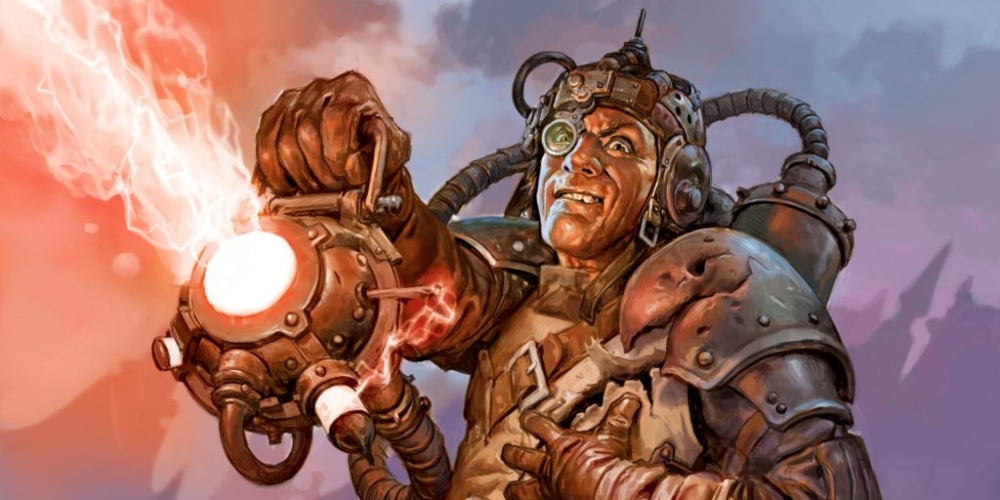
The Artillerist is the second of the ‘caster’ Artificer subclasses in D&D 5e, as opposed to the more weapon-oriented options. It’s also the most effective by far, able to beat most other subclasses at anything other than melee.
For its own features, the D&D 5e Artillerist Artificer subclass is a very competent blaster for a half-caster. Its bonus spell list is eye-watering, with some of D&D 5e‘s best damage spells (and Shield thrown in for good measure). Even though these come a couple of levels after Wizards get them, they put in the work.
Arcane Firearm is another welcome feature for the Artillerist in D&D 5e. A d8 might seem like a small amount of damage to add, but it’s the equivalent of upcasting most spells. It also applies to all targets (of one damage roll). Hit a crowd and it adds up quickly.
And this is without mentioning Eldritch Cannon, the D&D 5e Artillerist Artificer’s selling point. They can create one (later two) cannons from three types.
One is a straightforward ranged attack that does impressive damage and knocks foes back. Another is a more situational flamethrower that can broil an entire room if you pick the right moment. The Protector Eldritch Cannon can neuter entire encounters by giving your entire party respectable temporary hit points per turn.
These only get better as you progress. First, they get more damage and the ability to explode. Next, you can produce two at once to mix-and-match (or double down to ruin enemies’ days). They also provide half-cover to nearby allies, ideal for more fragile party members who want to hang back.
The Artillerist is one of the best D&D 5e Artificer subclasses for any fight. With preparation time, choosing the terrain themselves? They’re pretty much unbeatable.
This has been every official Artificer Specialist subclass in D&D 5e, ranked by their power. None are bad, all are good. Please play more Artificers. If you’ve enjoyed this article, please share it and check out other Artificial Twenty content, like the articles below.
For more help with the best Artificer builds, check out ‘The Best Artificer Races in D&D 5e‘ today. Please make more Artificers.
If you want unique builds across all D&D classes, ‘Fun D&D 5e Builds: How to Put a New Spin on Five Subclasses‘ might be more your speed.
 Artificial Twenty