Character-building is one of the most beloved parts of Dungeons & Dragons Fifth Edition, but it’s only one side of advancement. Characters get experience points and levels as they adventure, but they also get loot.
D&D 5e‘s magic item selection is wide and varied. Some are straightforward, desirable boosts like bonuses to attack and damage rolls. Others get more varied abilities, but still ones any character would want. Flight, teleportation, damage resistances, bonus spells, and more make up many lists of the best magic items in D&D 5e.
However, some magic items can fall through the cracks. Even though they have genuinely invaluable abilities, players don’t beg for them all campaign like a Broom of Flying.
It might be due to less flashy effects, situational benefits, or just because they lack cool names like ‘Vorpal Sword.’ However, there are plenty of underrated magic items in D&D 5e that you’ll be glad to have when the chips are down.
Updated September 20th by Artificial Twenty: Magic items have had their time in the sun with some D&D 2024 controversy. However, even after a decade, the magic items of D&D 5e are a delight – with some excellent choices that fall through the cracks. While adding more to this list, I also took the time to make some technical tweaks.
Clockwork Amulet Takes the Risk Out of Combat
Common Magic Item, Xanathar’s Guide to Everything

In theory, a D&D 5e enemy can have any Armor Class. In practice, however, the game’s maths makes an average roll a hit for almost all level-appropriate enemies. It stops combat from turning tedious and avoids disheartening players.
The problem, of course, is that dice don’t reliably roll averages. At least once, when you desperately need an attack to land in D&D 5e combat, you’re going to roll terribly. Defeat, death, and worse can follow.
The Clockwork Amulet is a Common D&D 5e magic item with a straightforward, once-per-day effect. On one attack, you can choose to not roll the d20 and get an automatic 10 instead. Notably, this still gets bonuses from Bless, Bardic Inspiration, and more.
As a Common-rarity magic item, the Clockwork Amulet isn’t going to light the world on fire, literally or figuratively. However, this effect puts it in the running for the best D&D 5e Common magic item, rivalling the ones that give free cantrips once per day.
When you absolutely need an attack to hit, the Clockwork Amulet is your friend. It’s best on a Paladin or Rogue but suits anyone who can hit hard with weapons or attack spells. A near-guaranteed Sneak Attack, Divine Smite, Inflict Wounds, or Plane Shift at the right moment can change the tide of battle.
Wand of Magic Detection Saves Spell Slots and Time
Uncommon Magic Item, Dungeon Master’s Guide

Detect Magic is a ubiquitous first-level spell in D&D 5e that is worth its (relatively inconsiderable) weight in gold. Knowing what magic is where helps with dungeons, traps, combat, social deduction, and more.
The Wand of Magic Detection gives up to three casts of this invaluable spell per day. If you come across a strange magic puzzle, want to highlight loot worth taking, or need to know who’s been buffed ahead of a fight, it can trivialise all three situations in a single long rest.
Some players discount the Wand of Magic Detection magic item in D&D 5e because there are other ways to get Detect Magic without spending a spell slot. There are Warlock Eldritch Invocations that provide it at-will, as well as certain lineage abilities. The spell itself can be cast as a ritual, taking ten minutes longer to cast it for free.
However, these all come with significant opportunity costs. You can’t guarantee your party members will be a Firbolg or Warlock. Neither does every D&D 5e adventuring day allow ten minutes of sitting and chanting magic words.
In those situations, your best option is to spend a first-level spell slot for Detect Magic. However, these aren’t limitless. They’re often better spent on D&D 5e spells like Healing Word, Shield, Absorb Elements, and more.
The Wand of Magic Detection mainly exists to save time and resources. However, that’s a perfectly good use case for an Uncommon magic item in D&D 5e. It lets you detect magic enough times to get you through the day without costing slots, character build options, or time.
Potion of Heroism Provides a Lengthy Combat Buff
Rare Magic Item, Dungeon Master’s Guide

Potions are a popular buff magic item in D&D 5e. The Potion of Heroism is a confusingly named magic item because it has nothing to do with the spell Heroism.
Instead, it provides temporary hit points and the effects of the Bless spell, as well as causing endless conversations as to why it’s not called ‘Potion of Bless’ instead.
Ten temporary hit points won’t change the game in many D&D 5e combats. That’s one attack from most enemies or two from something very weak. Instead, it’s the other effect that makes it invaluable.
Bless is one of D&D 5e‘s best combat buffs. A d4 to attacks and saving throws sounds minor. However, it pays for itself by the time it turns one or two failures into successes. This is true when it applies for a minute and occupies somebody’s Concentration.
The Potion of Heroism, despite not being as impressive as a Potion of Flying or Potion of Storm Giant Strength, improves on the Bless spell for a single target. Its effects last for an hour. You don’t need to spend a turn on a Potion of Heroism on the first turn of combat.
If you know a fight or two are coming up, you have the perfect chance to use this D&D 5e potion magic item.
And it’s not like ten temporary hit points are bad in D&D 5e.
Ring of the Ram Packs a Surprising Amount of Punch
Rare Magic Item, Dungeon Master’s Guide
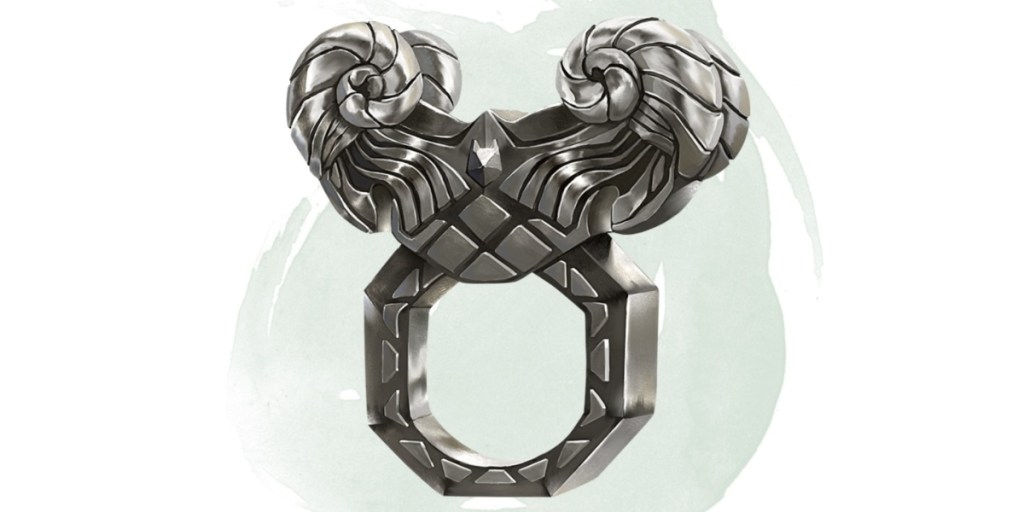
The Ring of the Ram is another D&D 5e magic item that’s easy to overlook versus others in its category. When rings can store other characters’ magic, boost your Armor Class and saving throws, or give resistance to a damage type, a slightly weird melee attack doesn’t seem all that impressive.
However, the Ring of the Ram has more going for it than meets the eye. Apart from anything else, its attack bonus is fixed at a more-than-reasonable +7 and its damage goes up to 6d10. Combat monsters might scoff at this, but it’s a reasonable fallback option for less melee-capable D&D characters.
For another thing, its attack moves the target up to 15 feet on a hit (depending on the charges spent). I’ve always been a big fan of forced movement in D&D 5e. Knock your opponent into a hazard. Throw them into a spell like Moonbeam or Wall of Fire. Clear yourself some breathing room. Chuck them at the Barbarian and run. Punch them off a cliff. The possibilities are endless.
Unlike many forced knockback effects in D&D 5e, Ring of the Ram doesn’t allow for a saving throw or a Strength ability check. Similar to Agonising Blast or the Crusher feat, it only needs to land. Square up to a Kraken or Giant, you can still throw them as far away as you can a mouse or human.
The Ring of the Ram’s magic attack in D&D 5e doesn’t provide a go-to option you’ll get endless use out of. Instead, if you’re clever, it provides the best type of weapon: one you only need use once.
Boots of Striding and Springing Are a Major Buff on the Right Character
Uncommon Magic Item, Dungeon Master’s Guide

Movement speed isn’t too much of a concern for most characters in D&D 5e. That’s because most characters get 30 feet of movement, similar to many enemies they face, and they don’t need to worry too much about it.
It’s a different story for characters who fall behind. Whether it’s from D&D 5e races like Halfling, Gnome, or Dwarf, or from armour they’re not quite strong enough to wear, low movement speed is painful.
The Boots of Striding and Springing magic item in D&D 5e is the perfect remedy for this. They enable slow characters to chase down enemies, get where they need to be in battle, or flee without lagging behind the rest of the party.
A Halfling can move as fast as anyone else with the Boots of Striding and Springing. Alternatively, a Dexterity-based character can benefit from heavy armour’s high AC (and possible magic benefits) and only need to worry about disadvantage on Stealth checks.
The ‘Springing’ part of this D&D 5e magic item can also go overlooked. Effectively being permanently under the effects of the Jump spell is no mean feat (or mean feet, either). It’s not as good as flight, but it’s a fantastic way to bypass obstacles, attack from unexpected angles, and navigate complicated environments.
It’s true that the Boots of Striding and Springing aren’t as great a mobility magic item in D&D 5e as the Slippers of Spider Climbing or Broom of Flying. However, they’re very good for what they are – something your DM is more likely to give you and not regret it.
Cloak of the Manta Ray Lessens One of D&D 5e’s Worst Environments
Uncommon Magic Item, Dungeon Master’s Guide

Try as they might, D&D 5e adventurers can’t escape underwater combat. It’s a hellish way to fight, causing 99% of characters to suffer reduced movement speed and half of their weapons being useless. That’s if they can even breathe.
The Cloak of the Manta Ray Uncommon D&D 5e magic item turns underwater combat into a character’s playground. Apart from letting a character breathe without requiring a spell, it gives them 60 feet of movement speed underwater.
Given the three-dimensional nature of underwater combat in D&D 5e, this effectively gives a character the Fly spell permanently, from an Uncommon magic item with no Attunement.
Ocean-based violence goes from something your character dreads to something they look forward to. It doesn’t help with the weapon issue, but it lessens the vast majority of problems with underwater combat.
For one character, at least. Everyone else is stuck slogging around unless you find a school of these D&D 5e magic cloaks. If Manta Rays don’t travel in schools, that doesn’t make sense.
The Claok of the Manta Ray is situational, there’s no doubt. When that situation comes knocking – and it inevitably will – you’ll still find it one of D&D 5e‘s best Uncommon magic items.
Rope of Entanglement is a Resource-Free, Non-Damaging Option
Rare Magic Item, Dungeon Master’s Guide

The Rope of Entanglement stands out as a D&D 5e magic item for one notable reason. It lacks any charges or use limitations, despite being capable of ruining an enemy’s day.
The Restrained condition isn’t the worst thing in D&D 5e, but it’s not something anyone wants to suffer. No movement. Disadvantage on the creature’s own attacks and advantage on all attacks against it. Disadvantage on Dexterity saving throws. None of it’s good.
The Rope of Entanglement can be used turn after turn, round after round, to ruin an enemy’s day. It doesn’t deal damage, but that’s not always the goal. It’s a good tool for characters like Bards who lack reliable at-will damage spells in D&D 5e. Setting an enemy up for a turn of pain is often more rewarding.
It has the added benefit of targeting most D&D 5e enemies’ worst saving throws. Dexterity is surprisingly weak for many NPCs in the Monster Manual and similar books. Even though the fixed DC is relatively low, it’ll land more often than you think.
The Rope of Entanglement is also an invaluable D&D 5e magic item for when you want to take someone down without killing them. It works very well against fleeing foes, non-combatants, and people who are more valuable alive.
Sure, it’s not among the most impressive magic items by rarity in D&D 5e. Being Rare means a Rope of Entanglement might take the place of something far better. However, it’s well worth trying out.
On top of its other benefits, it rewards creativity. It’s far more than just a combat tool. It has all the uses of a rope, plus the ability to entangle people twenty feet away with no difficulty. Scale cliffs. Save allies from high drops. Do things I can’t mention on this blog.
I once used it to secure my D&D 5e Artificer’s Steel Defender to a ship right before it jumped to the Astral Plane. It’s been a firm favourite of mine ever since.
If you’ve enjoyed this article, please share it with your friends and check out some other Artificial Twenty content, such as the suggestions below.
For unusual builds to complement your underrated D&D 5e magic items, check out ‘Fun D&D 5e Builds: How to Put a New Spin on Five Subclasses‘.
If you’re looking for more straightforward build advice, then ‘How to Multiclass in D&D 5e: Mistakes to Avoid‘ might be for you.
 Artificial Twenty