Cameron Strittmatter is the director of the video production company Failure Island and the host of TTRPG actual play channel The Panic Table. We got talking through a reader of mine and a fan of his.
This led to the fantastic opportunity to have a miscommunication about one interview time, and then sit down a couple of days later over Zoom. I was eager to learn about his TTRPG production journey.
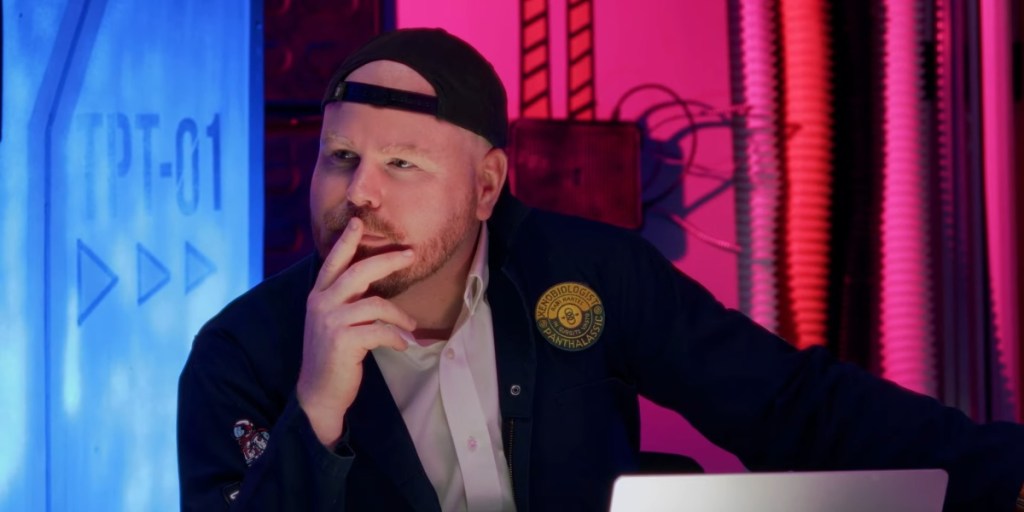
“First question. A classic, really. How did you get started with tabletop RPGs?”
“How did I get started? This is silly, I didn’t take the traditional route of Dungeons & Dragons. I’ve always been very interested in RPGs, played a lot of video games, so I was accustomed to the art of roleplaying. For me, well, are you familiar with the system Torchbearer?
It’s very much the version of Dungeons & Dragons that sits on its porch like ‘D&D? I’ve not heard that name in years.’ It’s quite grim, it’s by the folks behind Burning Wheel. In my opinion, it’s all the best things in Burning Wheel condensed into a more actionable adventure.
In the pandemic, we got to playing that, and after about a year, my table of friends were like ‘I think we hate this, this is such a hard system.’ I think broad strokes got us through some of the crunchier bits of the game. I’d probably played one-off games before that, but that was the beginning of the end.”
“If you only started in 2020, that’s quite a short time to go from hobby to production. How did that happen?”
“Isn’t that bananas? We just had our wrap party for Unaccompanied Miners, our show. I’d become part of a community of Mothership RPG third-party publishers. They’re just fabulous, really great people. One of them produced a fabulous game called Time After Time. It’s really attractive and very neat, just a great module.
About a year ago, I was spending a lot of time designing a Mothership module, just for funsies. I realised I was working on it more than hanging out with my wife. I became a man with his model trains in the basement type thing – no shame if that’s your thing, but it’s not what I planned on becoming.
That project was called Time After Time. I logged on six months later, just to see what the Mothership scene was doing. And someone else had taken the idea and the name and made a decent amount of money off it. So I said ‘What the heck?’ and that was the catalyst behind deciding to do something.
Upon reflection, maybe I should have tried to do something that actually made money. But we’re not here to talk about that.
I was sitting in our studio – by day we make commercial videos, mostly for software companies. It was a bit slow last fall, and I was looking at our array of cameras as I watched Dimension 20‘s Fantasy High Junior Year on Dropout. I was thinking ‘How hard can this be?’
Again, famous last words.
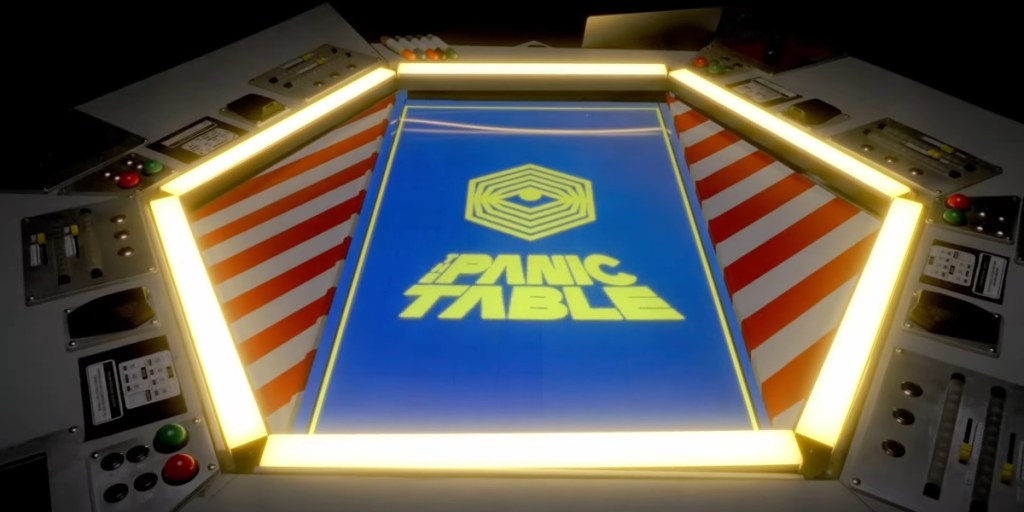
“So the Dimension 20 format appealed to you more than Critical Role‘s uncut, unedited, hundreds-of-hours-of-content type deal?”
“Precisely. I understand why people like that format, I simply don’t have the time for it. It’s so long – what a commitment.”
“So that’s how you got into The Panic Table, how did the rest of the group form?”
We sat down with The Panic Table, and we had several goals. We wanted to create something that wasn’t Dungeons & Dragons, so we did a lot of research into what system would work. We had a few ideas, such as the not-yet-developed The Magnus Archives system.
We wanted to find something that was a real upstart in the crowdfunding community. Mothership was one and a half years into its astronomical Kickstarter. Besides the money and, by proxy, notoriety, the community was really excellent. Looking into them, I was like ‘This is the one.’
You didn’t ask about Mothership, though.
The rest of the group came from our desire to replicate the tableside-of-friends feeling, the reason I watch these shows. I wanted to create something with the feeling of “These are my friends.”
So, we did what any sane person would do. We cast them from a group of strangers.
It was an in-depth interview process. What I always admired about Dimension 20 and similar shows was the chemistry, so that had to come first.
There’s a pretty curious thing in the States right now, where Los Angeles has a pretty stout actual play community – on top of all other forms of entertainment. Critical Role, Dimension 20, Good Times Society, and others. Here, you’d think New York City would have that. There are amazing AP producers and participants, but it doesn’t have that united feeling LA does.
So we wanted to make something that felt organic to the East Coast.
To answer your question properly, we held rounds and rounds of auditions. Rather than regular auditions where everyone reads for five minutes, we had these actors show up in eight groups of four. They would come in, and we’d just play Mothership. A lot of them had never played RPGs before, but we were mainly looking for good actors.
If you’ve watched the show, only Anuar (Saab) had prior experience with tabletop RPGs. Some of them had video game experience, but interfacing with the system had a fresh feeling that I was looking for. Rigorous casting, three rounds of playing Mothership, and seeing who clicked. I didn’t know any of them beforehand.”
“Since the start of The Panic Table, what are you proudest of?”
“Truly, finding the actors and what they brought.
There’s the banal metric side of things. It doesn’t look like much, but getting 1500 followers with no advertising budget, in an obscure system, was neat. I’d, of course, love to be growing faster, but it’s really cool to see it slowly growing on its own as Mothership takes off.
That’s the boring answer, that grassroots is kind of working.
I’m very proud of how it looks. It’s so pretty and colourful. That was one of our goals, given it’s a dark and gritty game, to have throwback vibes and colours, for it to punch way above its weight. I’d say it does that.
Beyond that, the cast really brought it. I didn’t know what to expect going in. By the end, it’s very operatic. I think the other nice thing with having actors not used to tabletop roleplaying is that they got really invested. Those decompression sessions weren’t just to create content, they were necessary because my friends were wigged out. We had bleed to work through together. The earnestness and the stakes were fresh and ever-present, which is more than I could ask for.”

“Going forward, in the next year, what are you hoping for from The Panic Table?“
“That is an exciting question. We’re teaming up with a new streaming platform, called Moonbeam, in the next month. They’re taking aim at Twitch. Their whole pitch is that it’s Discord and Twitch, except you make more money.
They came out of the weeds a few months back, having noticed The Panic Table. Their beachhead audience is going to be TTRPGs and the scene there. They were looking for somebody who looked and felt and smelt like Critical Role or Dimension 20 but wasn’t as affiliated with outside powers.
There’s also our Voidstream project, which we’ve announced. It’s not at-home video-on-demand entertainment. It’s video and audio clips for use in other people’s adventures.
We’ve been looking for an opportunity to team up with Tuesday Night Games – who produce Mothership – for some time. It took my wife saying ‘Why are you trying to learn publishing on top of everything else? Make videos, it’s what we do.’
Online game libraries have lots of visual and music assets, but I think they need more video assets. It’s plenty fun to act out or RP a farewell transmission or some terrifying footage, but how great would it be to say “This is what you see.” and show it?
Sometimes it will be well-known Actual Play actors and performers, sometimes it will be actors that we select.
And, of course, we want to do Unaccompanied Miners season 2. Because traction is taking a while, I would be surprised if we could raise the money needed to do it right.
We also teased a Gradient Descent narrative, Luke Gearing’s work within Mothership. He’s written the most phenomenal megadungeon inside a derelict android factory, all to the tune of Radiohead. It’s magnificent, and I would love to have it as a side narrative to Unaccompanied Miners with a different cast.”
“Looking back at the previous season, what is your favourite story moment in Unaccompanied Miners?”
“I don’t think it’s possible to name one that doesn’t involve Uzunma Udeh’s character Ndyia Baker. All of them have amazing tidbits – the things that would come out of Chris Kenkelen’s – playing Barry Benjamin’s – mouth.
But Ndiya would do these outrageous things in every episode. And you can see me in the show, especially the talkback sessions, going over just how wild it is for Uzunma to hop on the PvP horse and never get off of it.
You’re a seasoned DM and player, you know mastering PvP in a way that doesn’t wreck the table takes years, and a lot of trust. So for Uzunma to just throw herself headlong into these moments…
I think it began with a misunderstanding with a scientist – they’re all playing teenagers. So she’s standing in a hallway with Anuar’s character, and they’re worried about not being able to accompany their goals. And instead of working together, she just asks “Can I punch him in the face?”
And that was the beginning of the end.
From there, it’s downhill to Uzunma doing the most dastardly things as she works in total opposition to the rest of the table. Her choice to destroy the sensor that was saving android lives, for her to constantly defy the party…
Selfishly, I would say my favourite moment myself is when they first behold the horse. They were so ready for a Ridley Scott-type Aliens experience, legs and egg sacks. For this phantasmal, equine figure to appear over the ravine, it was thrilling from a showmaker’s perspective to get the response from the actors.
So it’s a tie between Uzunma punching Anwar’s character and a space horse.”
“Apart from Mothership RPG, what are some titles you play when you’re not on camera?”

“Oh, delightful. Have you heard of Cloud Empress? It’s not really fair because it comes from Mothership, but it’s its own thing. It’s genius, made using the Panic Engine to create a Miyazaki-branded Mothership game.
They’ve recently announced they’re separating their engine from the main console, so games can publish using the Panic Engine without calling themselves a Mothership experience. Watt’s Cloud Empress is the first endeavour. It’s very Scavengers Reign if you’ve seen that, a very magnificent, open-ended, curious, different feel to Mothership. I’ve very much enjoyed it.
Deathmatch Island really has my attention right now. It’s this combination of Squid Game and Lost and Battle Royale with a bit of Hunger Games in there as well.
For smaller fish, ones I find exciting, there’s a developer who goes by the moniker of ‘moreblueberries’, also Elliot Davis of Many-Sided Media. We’re acquainted because he lives in New York City as well.
He just published Rom Com Drama Bomb, are you familiar? It’s a three-player TTRPG where the DM plays a supervillain who has captured two people who are not attracted to each other, strapped bombs to them, and made them enact the villain’s favourite rom-com. You have to fall in love or die, all while also trying to figure out how to escape their clutches. I’m particularly obsessed with how winsome and silly it is, while also being emotional.
Gosh, I always look forward to playing Ten Candles, it’s possibly the peak of the art form.
Also looking forward to some from Jason Morningstar of Bully Pulpit Games. He made this exquisite game fraught with peril, historical peril. You play civil war deserters and it’s called Carolina Death Crawl. I’m dying to play it, but it requires seasoned players – it’s not casual.
Lastly, to the tune of our Voidstream project, Jared Sorensen, his outfit’s called Memento Mori Theatrics. He created this perverted – not in the pornographic sense – eerie game called Play. It’s a found-footage horror simulation game, quite a lot like The Magnus Archives.
You all play members of the Silver Keys Society, and you are all watching forbidden, unmarked tapes. One person plays the Camera, who then decides other actors. You go off of random cards, no dice, some banal, some absolutely terrifying. There’s no innate narrative, but it’s one of those games I like because players end up creating their own narrative every time.”
You can find The Panic Table’s social media here and Unaccompanied Miners‘ first episode here.
If you’ve enjoyed this interview, aside from checking out Mr. Strittmatter’s work, please do share this article and check out some more Artificial Twenty content. Thank you!
For more interviews with TTRPG stars, check out ‘An Interview with Veteran Homebrewer KibblesTasty‘. D&D 5e warning, for fans of other games.
For fans looking to expand their horizons, consider ‘The Best TTRPG Actual Play Series and Podcasts‘.
 Artificial Twenty