Intrigue and social-based adventures in Dungeons & Dragons Fifth Edition are quite a ways outside the norm. In a game that often revolves around head-on combat where the ability to deal and take damage is of the utmost importance, they favour a different set of skills.
Mysteries often make for low-combat D&D 5e adventures. Rather than charging headlong through foes, the main challenge comes from finding out who those foes are in the first place.
The main thrust of this sort of adventure in D&D 5e comes from gathering information. Talking to NPCs becomes more important than sticking a sword in them – although threatening to do so can help. Stealth is best used for snooping rather than setting up ambushes. Sending becomes more useful than Fireball.
As a result, how to DM D&D 5e mystery adventures can be a difficult attitude adjustment, particularly for Dungeon Masters used to adventures like dungeon crawls. Fortunately, there’s an endless array of possibilities – and a few useful tips to make any of them work as a mystery.
Almost anything can set up a D&D 5e mystery adventure. Solving a murder is the classic case – particularly if more bodies are on the way. That said, you can run intrigue-based D&D 5e adventures about almost anything. Finding an artifact hidden in a house, discovering what happened to a missing ally, or exposing a traitor can all be thrilling mysteries with these D&D 5e DMing tips.
Add Redundant Clues For Every Aspect of Your DnD Mystery

In real life, criminals try and leave as few clues about their crimes as possible. Fortunately, you’re (probably) not a real-life criminal. You’re a D&D DM trying to bait the hook for your players.
As a result, you want to leave more clues than you think you need to. No, more than that. More. In general, you should provide two or three times as many clues for every piece of information you want your players to learn in your D&D mystery adventure.
This isn’t because your players are stupid. However, D&D is a game of near-infinite possibilities. It’s very easy to get stuck on one track and assume the party will think like you do. In actual fact, they’re more likely to do everything but the one series of events you think makes logical sense.
If you leave one trail for the PCs to follow, they’re likely to miss it and smack headfirst into a dead end. Overload your mystery. Make the right people suspicious in as many ways as you need. Stuff the map with clues.
Crucially, also make these clues different, and gotten in different ways. It’s no use having three different NPCs with vital information if your players are searching through books.
If the players need to know that the killer spent an hour in the chapel, have muddy footprints leading there, a guard on lookout who’s convinced he imagined someone walking through, and signs of damage around a window.
Include, At Most, One Major Red Herring

Red herrings are a vital part of the mystery genre. This doesn’t change just because it’s a D&D 5e adventure. At the same time, they’re a tool to be very cautious with.
Apart from anything else, D&D is a time-consuming hobby that has to fight for its space in a social calendar. If your players spend their four-hour game night pursuing a dead end, they might feel like that’s time wasted.
Worse, you risk them losing sight of actual lines of evidence. Most D&D players’ notes are somewhat sprawling and about 75% complete (including mine, when I play). If there are too many red herrings, players might end up focusing on them to the point of forgetting about the important things you actually need them to do.
On top of that, D&D players build associations very quickly. If more than one lead sends them in the wrong direction, there’s a risk they’ll assume everything is a trick or twist with them as the punchline. This isn’t a helpful energy for enjoying your session or giving them actual information.
It’s a bit like the innate hatred of Mario‘s Toad for repeatedly telling us our princess is in another castle.
A red herring is good and fun. But make it a one-and-done so your players can eliminate it and get on with things. If they happen to get the wrong impression and charge after a wrong lead without your intervention, subtly give evidence against that fact.
Also, for your D&D mystery adventure, make your red herrings useful. Perhaps the sergeant of the guard isn’t the killer. But, once he’s confronted, have him able to provide some information. Have the investigation into the false lead carry the players forward elsewhere. If it’s not a dead end, there’s no risk of wasting the players’ time.
Don’t Have the NPCs Stand Still
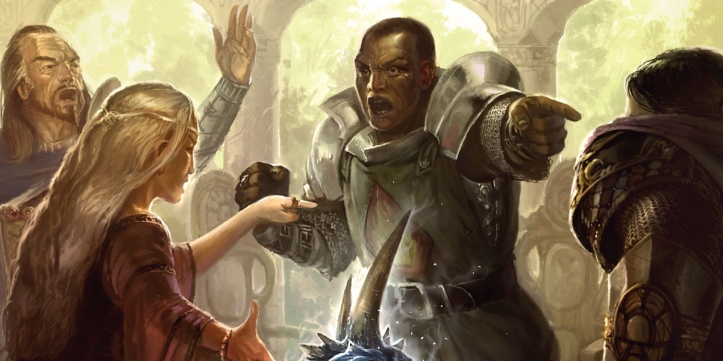
More than most types of adventure in D&D 5e, mysteries should be dynamic. Players will overlook enemies in a specific room for hours on end in a dungeon crawl D&D adventure – even if you should avoid it there as well. Less so in an intrigue-themed tale.
Mysteries work best when everybody involved is an active, breathing participant. The local guards begin kicking down doors and casting suspicion. Innocent but suspicious characters try and hide their unrelated secrets. The killer tries to throw off suspicion – or to kill again.
Imagine a D&D mystery adventure set in a big mansion – like a game of Cluedo. If every NPC stayed in their designated room, waiting to be spoken to by the PCs and doing nothing, it would start to feel fake and unrealistic very quickly.
Worse, it would start to feel boring. The PCs would be free to dawdle through the evidence, with nothing new happening to shake things up. At that point, you might as well have an empty setting where sheets of paper eventually tell the PCs everything they need to know.
Have the situation react to the PCs actions. Some NPCs can grow to trust them and volunteer information. Others can get suspicious, wondering if the party aren’t somehow involved in the treason. Some might even begin investigating on their own.
When the situation begins to move like a real-life crime scene, it pays dividends in more than immersion. It’s also the perfect way to nudge your D&D party off the wrong track, add more clues, and ratchet up the tension. If nothing else, a ticking clock is invaluable.
Try and Include Every Aspect of a DnD Adventure

Intrigue adventures in D&D 5e have a different focus from exploration or combat-focused stories. They use a different level of the core components of D&D gameplay. Often, social interaction and stealth rule the day, and skills like Insight and Investigation come to the forefront.
At the same time, this shouldn’t stand as the be-all and end-all of DMing your D&D mystery adventure. If every obstacle, clue, and complication is resolved through sneaking around and talking to people, that’s great for some members of your party. However, it can be bad for others.
Mysteries are often a low-combat adventure in D&D 5e. However, that doesn’t mean there should be none. Nor does it mean the only combat should come only in the epic climax when the villain, rumbled, makes their final stand.
Plenty of mystery stories have incidental violence to drum up the stakes. An assassin attempts to stop the party’s investigation in its tracks. An unrelated antagonistic group attempts to take advantage of the chaos. If things go very poorly, maybe well-intentioned guards try and take the party into custody.
Honestly, it’s D&D. Have some ghosts attack or something.
Any Fighters or Barbarians in your party will thank you for getting to use their toolkit in a D&D mystery adventure. Even more flexible spellcasters can enjoy the trade-off between being combat-ready or having more versatile investigation tools.
It’s not just about combat. Try not to force players to rely on one or two skills or a go-to approach to solving things. Include a mixture. Locked rooms to explore. Busy areas to sneak across. Slovely guards to intimidate. Clues that need magic to find. Occasional people to murder.
Even in this type of D&D adventure, make sure everyone gets their turn to shine.
Account for Mystery-Busting DnD Spells

High-level mysteries are very difficult to DM in D&D 5e, and magic is the main reason why. Higher-level magic in D&D 5e gets somewhat better at killing things and ridiculously more effective at breaking your investigation in half.
Scrying, Commune, Dominate Person, Legend Lore, True Seeing, and many more high-level spells can prevent even the craftiest of D&D DMs from hiding anything from their players. By the time they have those, mysteries are effectively small speed bumps.
Even at lower levels, there are plenty of spells Poirot would kill to have. Zone of Truth, Speak with Dead, and Detect Thoughts are just three examples that can make DMing a D&D mystery adventure stressful. Disguise Self is also ridiculously useful.
Don’t ban these spells. Simply account for them in the mystery you create. Prepare misleading (but honest) answers to counteract likely questions in a Zone of Truth. Speak with Dead doesn’t function if the corpse can’t speak. If your villain practises some tasteful corpse desecration, it’s suddenly a whole new part of the adventure to find and reattach the jaw before asking questions.
NPCs won’t enjoy having their thoughts probed and might honestly be suspicious of all magic. Force your PCs to get creative, rather than just spamming the best D&D 5e spells to bypass well-known mystery obstacles.
Don’t metagame to make these options useless. At the same time, do have an idea of what your PCs can do and prepare countermeasures to not trivialise the entire adventure. It leaves some egg on your face if a lucky Detect Thoughts finds the traitor in six seconds.
Give the Players Some Clear-Cut Allies

This ties in with limiting your red herrings in how to DM a D&D 5e mystery adventure. Everyone in your adventure can be a suspect, with enough missing information and suspicious hints to be a possible villain. However, things run smoothly if you have some people who are clearly on the players’ side.
Apart from keeping things moving in the right direction (by cutting down on lines of inquiry), this can also give your players a feeling of stability. Not everyone is potentially out to open their throats. They have some NPCs they can rely on and not second-guess every interaction with. It’s a nice saver on mental strain.
It’s fairly easy to clear some NPCs to be obvious player allies for your D&D adventure. Give them obvious and well-known alibis. Hell, have them with the PCs when the inciting incident happens, if it’s a murder-mystery type of adventure. If the players look to be questioning their innocence, find ways to reinforce it until they accept that no, this is not a trick.
On that note, do try and resist the urge to betray your D&D players if they’ve formed genuine trust with an NPC. I explain why in this article about bad tropes for D&D DMs, but it mostly boils down to the few moments of shock not being worth the campaign-wide ramifications for your players not trusting NPCs.
Friendly NPCs are more than just nice to have in a D&D 5e mystery adventure. They can also provide skills the PCs lack, be it a certain type of spellcasting, authority over the crime scene, the ability to sneak. Wait for the PCs to use these tools, however, rather than offering the solutions to your own problems.
Basically, give them a Lestrade to their Sherlock Holmes. Just hopefully without the antagonism.
Don’t Be Afraid to Nudge Players Through Your DnD Mystery

More than any other D&D 5e adventure type, mysteries run the risk of your players getting stuck. They miss evidence. They hit too many dead ends. They end up with no firm conclusions and no idea of where to go next.
Most D&D players are not genius detectives in real life. Even genius detectives get stuck. Nothing feels worse than your fun D&D adventure grinding to a halt because of bad luck or a couple of poor decisions on your players’ part.
It might feel like cheapening your D&D 5e adventure or railroading the players to give them a shove back to where they need to be. Honestly, maybe it is. But either one of those is better than your players banging their heads against the wall for four hours on their evening off.
With that said, try not to be too obvious. Don’t literally tell the players where to go out-of-game, or have an NPC pop up to give them instructions. You still want to maintain immersion and make the players feel in control. Even if they notice you nudging the wheel, it should be plausibly deniable.
Maybe an NPC anonymously leaves a clue on one of their beds – which both helps propel them forward and adds a new element of intrigue in who this potential ally is. Maybe a fight breaks out and draws their attention, which in-turn leads them to something invaluable.
There are endless ways to keep your players moving in your best D&D 5e adventures, including in a mystery-themed one. It helps to be light on your feet and ready to tweak things a little bit to make the puzzle slightly easier to solve.
These have been seven tips for running a mystery adventure in D&D 5e, plenty of which apply to more general stories and sessions.
If you’ve enjoyed this article, please do share it with your D&D DM friends. Do also check out other Artificial Twenty content, such as the suggestions below. I really appreciate it!
When violence does break out in your D&D mystery adventure, ‘How to DM D&D 5e Combat: Common Mistakes to Avoid‘ is what you want.
While you won’t find many murder mysteries in ‘The Best Media to Help You Improve as a D&D DM‘, it’s still got plenty of relevance.
 Artificial Twenty