The Rogue isn’t necessarily the most powerful class in Dungeons & Dragons Fifth Edition. However, it’s a time-honoured classic since the game’s first expansions, one of the iconic RPG character archetypes, and widely beloved as a D&D 5e class.
A D&D 5e Rogue build also fills vital party roles as an out-of-combat expert capable of bypassing or overcoming problems with their vast toolbox. This makes them one of the more exciting “martial” classes to build and play.
Rogue subclasses in D&D 5e are inconsistent in their power level. Some always have the right tools for the job while others are hopelessly situational. When a Rogue subclass underwhelms, it really underwhelms. However, this goes both ways. The best D&D 5e Rogue subclasses really do blow the competition out of the water.
Soulknife Rogue Can Succeed at Almost Anything
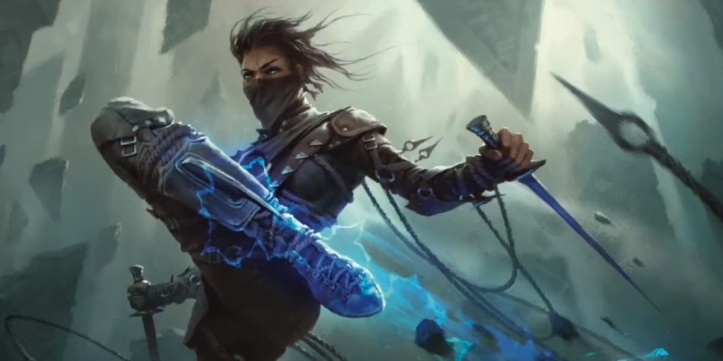
The Soulknife is one of the last D&D 5e Rogue builds released. It uses psionic powers both in and out of combat, often in ways that can make the DM’s eyes water.
Like most psionic subclasses, it has flexible resources in the form of Psionic Energy dice. You don’t need to worry about limited uses for specific abilities because they almost all share the same resource pool. This makes the subclass perfectly adapted to any sort of adventuring day.
The Soulknife Rogue’s abilities match this level of reliability and sheer usability. Psi-Bolstered Knack is a dice roll bonus to ability checks — the thing a Rogue excels at more than anything else in D&D 5e. With Expertise, Reliable Talent, and up to a d12 for free, you’re a self-contained skill machine who can succeed at almost anything.
What makes Psi-Bolstered Knack truly absurd as a D&D 5e Rogue ability is its usage cost. You only expend your Psionic Energy if the roll succeeds. If, somehow, you still fail, it costs you absolutely nothing to have tried.
Psychic Whispers and Psychic Veil are two other invaluable out-of-combat abilities. Telepathic communication and magical invisibility clearly excel in an infiltration scenario (read: Rogue things), but are flexible for almost any adventuring situation. Get creative enough, and these abilities can warp most challenges.
This hasn’t even touched on the D&D 5e Soulknife Rogue’s combat prowess. Psychic Blades is a hard-hitting, flexible way to trigger your Sneak Attack. On top of that, it deals one of D&D 5e‘s best damage types, averting early-game Rogue weaknesses.
Conjuring two Psychic Blades gives you a free bonus action attack that doesn’t use the two-weapon fighting rules. It can’t trigger Sneak Attack twice, but it does give you a second chance if the first misses. Alternatively, a second attack can just be a good way to deal damage if there are no better Cunning Actions to take.
Psychic Blades can also be thrown from range without having to worry about drawing new weapons. It’s a small bit of tactical flexibility, but welcome.
At later levels, a Soulknife can effectively add Psi-Bolstered Knack to their attack rolls. Similarly, this doesn’t cost anything unless the attack hits. You can also teleport using your Psychic Blades, providing a (somewhat inconsistent) boost to the Rogue’s mobility.
With top-tier skills outside D&D 5e combat and versatile tricks when in a fight, the Soulknife has many glaring strengths and very few glaring weaknesses. You can’t take Opportunity Attacks with Psychic Blades, but there are ways around that.
All in all, that’s a pretty acceptable drawback for just how powerful the D&D 5e Soulknife Rogue subclass is.
Swashbuckler is Violent but in a Charming Way
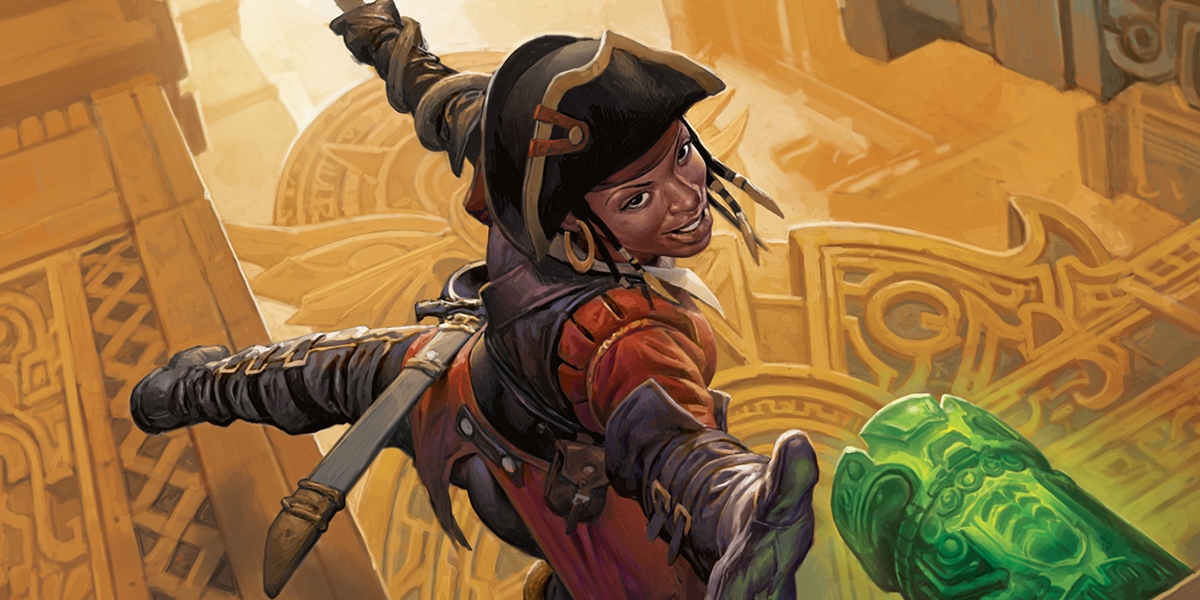
The Swashbuckler is one of D&D 5e‘s most popular Rogue subclasses. This is partly for its flavour, which calls to mind Inigo Montoya, Jack Sparrow, and countless other dashing movie heroes.
It’s also partly because it’s a beast of a D&D 5e Rogue build.
Almost every Swashbuckler Rogue ability is combat-focused. Rakish Audacity, aside from giving a welcome Initiative boost, stops Rogues needing allies (or advantage) to trigger Sneak Attack.
In a one-on-one situation (or just more than five feet away from other combatants), you can hammer your enemies with damage every turn.
Fancy Footwork is perfect for a Rogue’s hit-and-run playstyle. When you don’t need to use your bonus action to disengage, it opens up plenty of options. You can Dash, Hide, wield two weapon (for a second chance to Sneak Attack), or exploit countless other combat actions.
Darting next to an enemy, hitting them with Sneak Attack, and then getting 60 feet away with no Opportunity Attack is a great way to infuriate them and your Dungeon Master.
Panache is an unusual D&D 5e Rogue subclass ability in that it’s a tanking feature. However, it fits the flavour well and makes sense for a subclass that excels in a head-to-head duel. Buy your allies some breathing room and skewer the boss with a rapier a few times. If you combine it with Fancy Footwork, even better.
Neither Elegant Maneuver nor Master Duelist are world-beating class features. Nonetheless, (effectively) free advantage on Athletics and Acrobatics checks isn’t something to sniff at. Master Duelist basically lets you decide not to miss (unless you get very unlucky), which few people are going to complain about.
While the D&D 5e Swashbuckler’s abilities are all combat-focused, it does tie into other situations. Rakish Audacity encourages at least some investment in Charisma, as does the class fantasy.
With even a few points in Charisma, you can use your Expertise to become the party’s go-to social charmer. When that doesn’t work out, you can still throw down with the best of them.
Arcane Trickster Gets the Game’s Best Tool

Spellcasting in D&D 5e is undeniably powerful. Most of the best classes have access to all the magic they can dream of. It has near-endless uses both in and out of combat. As a result, it’s not that surprising when D&D 5e‘s best Rogue subclass is the one with magic.
Even with a tiny number of spells known, few spell slots, and restrictions to two schools of magic for most of them, the Arcane Trickster has unbridled flexibility. Enchantment and Illusion are perfect schools for most Rogue things.
Use Silent Image or Minor Illusion to create distractions. Become even better at infiltration with Disguise Self. Aid cons with Charm Person. Or use your magic for non-illegal things, because there genuinely is more to a Rogue than criminality.
Almost anything a D&D 5e Rogue build can do, it does better with magic. With this feature alone, the Arcane Trickster would be a powerful Rogue subclass in D&D 5e.
But wait, there’s more.
Mage Hand Legerdemain is a huge boost to something that is already one of the best cantrips. Pick locks and pockets while you do other things, from a safe distance, without anyone noticing anything. Other Rogues wept.
Versatile Trickster is another Mage Hand buff, albeit one that is more situational. Nonetheless, bonus action advantage makes it very difficult to not get Sneak Attack, so it’s worth keeping in mind.
On that subject, the Arcane Trickster is also the best D&D 5e Rogue subclass for outright combat. Sometimes things just aren’t fair.
With Green-Flame Blade or Booming Blade, Sneak Attack hits harder than ever. Up to 3d8 bonus damage, with even when you use them properly, you’re more of a force in melee than other Rogues are anywhere.
Magical Ambush makes crowd control spells viable, assuming you don’t mind spending the slots. Shutting opponents down and then picking them off while they’re helpless is a very Rogue way to fight.
You can also use your limited any-school spells to pick buffs if you’re not in the mood for direct damage or utility. A D&D 5e Rogue Arcane Trickster build with Shadow Blade can pile on the pain, and that’s just one example.
Rogues already have a large toolkit. The Arcane Trickster dwarfs them with access to the game’s best tools. As a result, it’s a clear contender for the strongest Rogue subclass in D&D 5e.
These have been three D&D 5e Rogue subclass builds and why they’re the best in the game. Other subclasses are good, truly, but these outstrip them in power, versatility, or both.
If you’ve enjoyed this article, please do leave a like. Also check out some other Artificial Twenty content, such as the suggestions below! It really does mean a lot.
Those looking to optimise their D&D 5e character creation beyond race and subclass might want to check out this guide on boosting each class’ damage.
Alternatively, those still making their big decisions should read this guide on the best D&D 5e Druid subclasses.
 Artificial Twenty