The Warlock is one of the best classes for character customisation in Dungeons & Dragons Fifth Edition. Alongside the race, background, subclass, and feats every D&D 5e character gets, it has unique Eldritch Invocations to help each Warlock stand out.
This new layer presents excellent opportunities for building the best Warlock in D&D 5e. However, like many systems in the game, not every option is equally attractive. Some are clearly top-of-the-range, others are functional and fun, and others still are dead weight.
Most Warlock Invocations in D&D 5e make for a fine addition to a Warlock’s toolkit. It’s merely the extremes most players want to be wary of. There’s nothing wrong with taking any option, but it’s worth knowing which are the best Eldritch Invocations in D&D 5e, and which are the worst.
Updated November 5th by Artificial Twenty: Make no mistake, these are still the worst and best D&D 5e Eldritch Invocations. However, this article has been around a long time, and the way I write has changed. This update makes it flow better and more like my current content.
The Best Warlock Eldritch Invocations in D&D 5e
I’m not necessarily saying these will all be mainstays of every D&D 5e Warlock build. They can be dependent on the sort of campaign you’re running. However, you’re very unlikely to be sorry you picked these D&D 5e Eldritch Invocations.
Agonising Blast Doubles a Warlock’s Damage Output

We might as well start with the clear standout choice for Warlocks in D&D 5e. Agonising Blast is deceptively innocuous, given it’s an optional modification for an optional cantrip. Make no mistake, however, Eldritch Blast and its upgrade are choices in name only.
Eldritch Blast makes most Warlock builds in D&D 5e. It’s a reliable ranged attack that uses their best ability score. Agonizing Blast is what seals it as D&D 5e‘s best cantrip. Adding Charisma to every beam effectively doubles a D&D 5e Warlock’s damage output from eighth level onward.
The Agonizing Blast Eldritch Invocation lets a D&D 5e Warlock keep up with the average Fighter’s damage output (without feats) for a minimal investment. It leaves other spellcasters in the dust for their at-will damage. On nearly every occasion, it’s the most reliable option in a Warlock’s arsenal.
Agonizing Blast isn’t quite a mandatory tax, despite being the best Eldritch Invocation in D&D 5e. However, that’s only because people have put extensive thought into making Warlocks who can thrive without it. For most, it’s near-essential.
Devil’s Sight Improves An Evergreen Ability

Darkvision is an important part of adventuring in D&D 5e. So much of the game takes place underground, at night, in ruins, and in many other places the lights don’t work. Seeing is a pretty vital part of adventuring.
A lack of darkvision is the one thing holding back Variant Humans as a D&D 5e lineage.
Devil’s Sight doesn’t just provide darkvision. It lets a character see normally in dim light or darkness for 120 feet. Other than being double most darkvision range, it ignores the automatic disadvantage on Perception checks from seeing things in dim light.
A Warlock with the Devil’s Sight Eldritch Invocation in D&D 5e is well-equipped for far underground, forgotten dungeons, or the Shadowfell itself.
Unlike Darkvision, Devil’s Sight can also see through magical darkness, including the Warlock’s own. Apart from negating a magical hazard, this opens up a combination wherein the Warlock gets advantage on all attacks against enemies within that darkness.
Just be careful to leave your allies some targets, or you’ll have one of D&D 5e‘s best Eldritch Invocations and no party to better with it.
Book of Ancient Secrets Provides Unmatched Spellcasting Utility

Book of Ancient Secrets is a pact-specific Eldritch Invocation in D&D 5e. It improves the already-flexible Pact of the Tome by offering more than just cantrips.
As a D&D 5e Eldritch Invocation, Book of Ancient Secrets is similar to the Ritual Caster feat. The Warlock gains two ritual spells they can cast, with the option to put more rituals they find in their book for a gold and time cost.
The difference is that Ritual Caster, already a powerful spellcasting feat in D&D 5e, is limited to one class. Book of Ancient Secrets covers literally any ritual spell in the game, from any spell list, with no need to choose at any point.
It’s this flexibility that makes Book of Ancient Secrets such a good D&D 5e Eldritch Invocation. Their low Pact Magic slots make combat spellcasting limited. Between other at-will spellcasting Invocations and Book of Ancient Secrets, a Warlock can have utility spellcasting unmatched by even the Wizard.
If you want a character who can cast a smattering of Warlock, Wizard, Druid, Sorcerer, and Bard spells outside combat, Book of Ancient Secrets is the D&D 5e Warlock Eldritch Invocation for you. Just be prepared to spend some gold.
Mask of Many Faces Has Unmatched Social Utility

Now, this Eldritch Invocation comes with a disclaimer. Mask of Many Faces, which gives the Disguise Self spell at-will, is primarily useful in specific types of adventure.
I’m not saying Mask of Many Faces is a bad D&D 5e Eldritch Invocation for more combat-heavy or dungeoneering adventures, but it’s far more situational. Instead, it’s unparalleled for stealth, social, and intrigue-based stories.
The ability to change your appearance at-will, including clothes, has utility only limited by the player’s imagination. A D&D 5e Warlock can use it to commit crimes with impunity, bluff their way into secure areas, implicate others, access confidential information, and far more.
Mask of Many Faces isn’t limitless. NPCs can see through it with an Investigation check (or perhaps if the player rolls some very poor Charisma checks). At the same time, its flexibility, wide range of uses, and almost non-existent cost make it the best Warlock Invocation in D&D 5e for social situations (as long as you don’t mind lying).
The Worst Warlock Eldritch Invocations in D&D 5e
There is a common theme among bad D&D 5e Warlock Invocations. Despite literally being tailor-made for the class, they don’t gel with its design. Either they provide resource taxes that a Warlock can’t afford, they waste the class’s genuine strengths, or they just underperform in practise. Some manage all three.
Sculptor of Flesh is a Poor Fit for Warlocks

There is a particularly underwhelming type of D&D 5e Warlock Eldritch Invocation found primarily in the Player’s Handbook, of which Sculptor of Flesh is one.
Eldritch Invocations that let a Warlock cast a non-Warlock spell, once per day, using a Warlock spell slot are almost never worth it. Polymorph, which Sculptor of Flesh gives access to, is undeniably one of D&D 5e‘s best spells. However, the sheer number of hoops the Eldritch Invocation requires makes it thoroughly underwhelming.
A seventh-level Wizard can cast Polymorph at least twice per day, with plenty more spell slots besides, and gets more uses as they level up. A Warlock with the Sculptor of Flesh Eldritch Invocation can only ever cast it once. On top of that, it costs a limited Pact Magic slot.
Even though it’s eye-wateringly powerful, Polymorph is also a poor choice for a Warlock spell slot. It doesn’t scale in any way when upcast, meaning ninth-level and higher D&D 5e Warlocks will be spending a fifth-level spell slot on a fourth-level spell.
For its restrictions, poor interaction with Warlock mechanics, and flat-out disappointing nature, Sculptor of Flesh stands out as one of D&D 5e‘s worst Eldritch Invocations.
Relentless Hex Will Almost Never Pay For Itself

To its credit, Relentless Hex is an original and creative Eldritch Invocation in D&D 5e. It’s a bonus action, 30-foot teleport that delivers the Warlock next to the target of Hex, Hexblade’s Curse, Sign of Ill Omen, or a similar feature.
It’s not boring, and it’s certainly not useless. However, it’s situational to the point of being less useful than some of the other worst Eldritch Invocations in D&D 5e.
A thirty-foot teleport is often useful in D&D 5e. However, one that only delivers you next to a specific enemy is far too restrictive. It can’t be used for utility or retreat, only to press the attack.
The only Warlocks who want to repeatedly close to five feet are melee Hexblades (or other Pact of the Blade builds). Even then, they will usually pick a nearby target for their Hex, Hexblade’s Curse, etc., rather than one who needs legwork. Once you’re in melee in D&D 5e, you’re usually stuck until someone dies.
Even if a target does unexpectedly get far away, they have Eldritch Blast for a reason. On top of that, the best Hexblade builds in D&D 5e typically use their bonus action to attack anyway.
You might think that you could use this as a workaround by casting Hex on an ally and teleporting to them. However, Misty Step also costs exactly one Pact Magic slot, is far more flexible, and doesn’t require you to kill your friend to target something else with Hex.
Relentless Hex does expand a player’s options, but only with a tool so situational they might forget about it when it comes up.
Thief of Five Fates Suffers a Common Pitfall

Thief of Five Fates is another D&D 5e Warlock Eldritch Invocation that gives one cast of a spell per day that costs a Warlock spell slot.
Even worse, it picks an underwhelming D&D 5e spell. Bane isn’t the worst spell in the edition, but it’s often disappointing. It requires a failed saving throw to inflict a moderate (but relevant) debuff to enemy attack rolls and saving throws. In general, Bane’s counterpart Bless is almost always more worth casting.
If you want to make Bane an integral part of your strategy in D&D 5e, you probably want to cast it more than once per day. Otherwise, almost any other Warlock spell in D&D 5e is a better choice.
To rub salt in the wound, Bane doesn’t upcast very well. Rather than becoming more potent, it only affects more targets. From ninth level onwards, you’d need six enemies at once every day to avoid wasting this D&D 5e Warlock Eldritch Invocation’s limited potential.
If you do want to cast Bane as a D&D 5e Warlock, a single-level multiclass (such as Bard) will provide it far more reliably and flexibly.
Undying Servitude is Hideously Limited
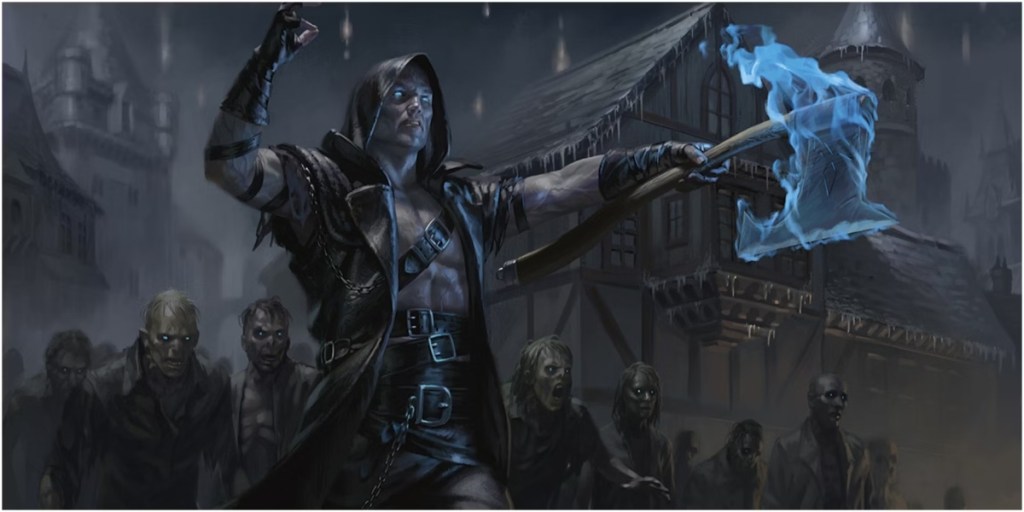
Undying Servitude is tragic as a D&D 5e Warlock Eldritch Invocation. It’s a genuine attempt to fix the design of other non-Warlock spell Invocations. However, its particular implementation falls right off a cliff.
In D&D 5e, the Undying Servitude Eldritch Invocation lets Warlocks cast Animate Dead once per day. Given the class’s association with dark magic and the inherent appeal of necromancy, it seems a dream combination.
The downside is that Animate Dead is a thoroughly underwhelming spell when cast once per day. Undead are weak individually and terrifying in great numbers. Most D&D 5e Necromancer builds aim for the latter, enabled by being able to cast the spell multiple times.
Worse, this is one time you might actually want to use a Warlock spell slot for an Eldritch Invocation in D&D 5e. Animate Dead upcasts well, animating or reasserting control over multiple creatures for each slot. However, as Undying Servitude doesn’t use a slot, it furthers its position as one of D&D 5e‘s worst Eldritch Invocations shutting down this option.
With this Eldritch Invocation, you can spoil yourself with one whole skeleton or zombie to slow the party down and perish easily in combat. I guess ‘Quickly Dying Servitude’ didn’t have the same ring.
Due to Animate Dead’s exact wording, it doesn’t look like you can get more even if you spend several days preparing multiple zombies and trying to reassert control.
These have been four of the very best Eldritch Invocations for Warlocks in D&D 5e, and four of the worst. Please do check out other Artificial Twenty content, share this article around, and leave it a like. Thank you!
For more build advice, check out this article on D&D 5e‘s best Wizard races or this one on the best gish subclasses in D&D 5e.
If you have the mechanics down, you might instead want ‘Tips for Writing a D&D Character Backstory‘ for some advice.
 Artificial Twenty