This is probably going to become a recurring theme on this blog. I like gish builds in D&D 5e. They’re great. I tend towards martial characters on the whole. When I want to play a spellcaster, one who can still kill things with a sword tends to appeal.
As discussed in the previous article on this blog Four D&D 5e Gish Multiclasses to Show They’re Not All Hexblade Paladins, multiclassing is sometimes used when people really want that gish-y feel.
However, this gives rise to multiclasses some consider ‘cheese’, such as the infamous D&D 5e Sorcadin multiclass build. Not every game allows multiclassing, and some multiclasses take a while to get off the ground.
So when they don’t cut the mustard, for whatever reason, there are plenty of more conventional D&D 5e subclasses for both martial and caster classes that look to blend magic and swordplay.
Now, as discussed, not all of those are one hundred percent satisfying for a gish playstyle, but they’re all more than sufficient. Below, we’ll discuss the five best subclasses for gish builds in D&D 5e.
Updated March 28th by Isaac. D Craddock: This has consistently been one of my more popular articles, but it wasn’t previously up to the standard of more recent ones. As a result, I’ve updated it to bring it more in line with my newer content.
The Eldritch Knight Fighter Is Almost Unbreakable

I’m going to reiterate this every time I write a post here that criticises the Eldritch Knight subclass in D&D 5e: I love the Eldritch Knight.
It’s genuinely one of my favourite subclasses of my favourite D&D 5e class. It plays great and it’s one of the single tankiest characters you can make. Its issues do not lie in its overall performance. Instead, its issues are squarely in how it interacts with the gish fantasy.
The Eldritch Knight subclass in D&D 5e has low spells known, few spell slots, and a restriction on the spells they know to largely two schools. One of these schools, Evocation, is largely not useful to them and not the best for gishing either.
Fireball is a very impressive spell. It’s less impressive when you cast it at Level 13, twice a day, with a low saving throw because Intelligence is your tertiary stat. That’s how a lot of the Evocation school goes for a third-caster like the Eldritch Knight.
The Abjuration school is infinitely more useful for a D&D 5e gish build but doesn’t necessarily fit into the fantasy, where magic is used just as much to enhance attack as it is for defence.
The non-restricted spells help somewhat, but you only get a few of those (one per spell level). For instance, Shadow Blade is a powerful and thematic spell for a D&D 5e gish build, but you need to get to 8th level before it’s a real possibility, and you don’t have many spell slots to cast it with.
One of the Eldritch Knight’s saving graces as a gish is its seventh-level feature, War Magic. Casting spells and then attacking very much lines up with a gish. It’s also a top-tier damage option for D&D 5e gish spells like Booming Blade. Other combos can be situationally useful – Lightning Lure followed by a melee attack is a combo I’m very fond of.
Some other D&D 5e Eldritch Knight features also lean into the fantasy of a magical warrior, such as summoning weapons to your hand (think Thor), or teleporting around the battlefield. The Eldritch Knight does combine magic and melee passably well. It’s also a strong subclass to boot. However, it can leave players disappointed on a pure fantasy front.
The Battle Smith Artificer is a Support Warrior with a Pet
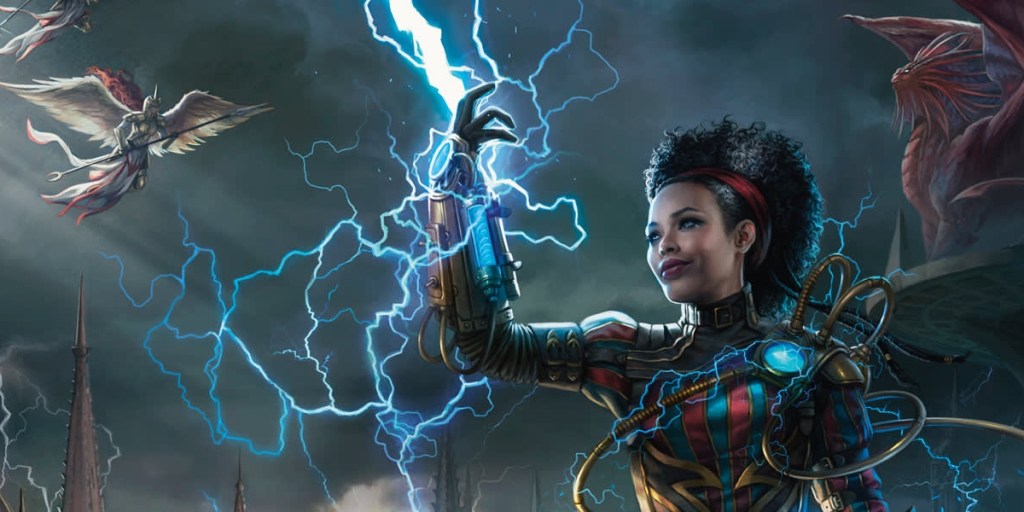
The D&D 5e Artificer is in an unusual spot. It’s the first Arcane half-caster added to the game, which some thought would make it a gish by default. However, due to the Artificer’s design, the other half isn’t necessarily ‘Martial’.
The class covers a wide variety of roles, giving it a clear design space away from the Paladin and Ranger. The Battle Smith is the D&D 5e Artificer’s most martial subclass, dueling with the Iron Man-esque Armorer for dominance.
The Battle Smith Artificer in D&D 5e gets proficiency with martial weapons and the ability to make attacks with its Intelligence. This sets it up as a durable and easy-to-build gish in D&D 5e that is comfortable on the front lines The bonus spells aren’t necessarily the most combat-oriented, but they get Shield and one of the better Smite spells.
All of this gives a good foundation for a gish, and there’s absolutely no reason the Battle Smith can’t be played as one. You can sling spells and hit with weapons all day – or at least until you run out of spell slots. However, two points count against it in this regard.
The first is the Steel Defender. I may be alone in this, but when I picture a gish build in D&D 5e, I imagine a warrior who fights primarily on their own (obviously, with a party), with a certain self-sufficiency, hence the blending of magic and swordplay.
However, a fair amount of the Battle Smith’s power budget goes into its Steel Defender, a pet that can attack, project battlefield control, protect (it’d be poorly named otherwise), and with certain features, channel your healing and discount smiting. It’s a great feature, and I fully have plans to play a Battle Smith and make great use of its Steel Defender. However, it’s not something that most people incorporate into a gish class fantasy in D&D 5e.
A more minor point is that the Artificer spell list also lacks some of the wizard and warlock’s best gish spells. No blade cantrips, no Shadow Blade, no Misty Step, no Mirror Image. The Artificer spell list still has some good gish spells. However, most of its options are utility or support.
It’s not terrible, by any means, and certainly doesn’t stop the Battle Smith Artificer from being one of D&D 5e‘s best gish subclasses, but it’s lacking in some areas that other subclasses do better.
The College of Swords Bard Is Well-Named

The College of Swords sits in an unusual spot amongst Bard subclasses in D&D 5e. It occupies just enough of a different design space to the College of Valour, its cousin, that it’s not an update, but it definitely feels like it’s an attempt to improve over that.
The College of Valour is perfectly serviceable as a D&D 5e gish subclass, as discussed in previous articles. However, had the poor luck of being opposite the College of Lore, one of the best subclasses in D&D 5e bar none, and so it went underplayed.
Like the Bladesinger, the College of Valor Bard lacks any real motivation to get into melee until higher levels. In general, the designers of D&D 5e seemed to think Extra Attack was all the motivation a character needed to fight in melee.
Luckily, the College of Swords Bard subclass in D&D 5e has a bit of a design update on this. All of its features encourage weapon attacks in some way, giving it discount-Battlemaster abilities when it uses Inspiration dice, a Fighting Style, and, of course, Extra Attack.
At higher levels, they get their discount Maneuvers for free once per turn, alongside unmatched spell versatility that can include any buff in the game. It makes for a spellcaster that, while unlikely to be your primary frontliner, can sit out in melee more comfortably than a Bladesinger gish build in D&D 5e.
Magical Secrets and the Bard spell list continue to make the class one of the best gish builds in D&D 5e. The Bard can take any spell from any spell list in the game and tailor itself to pretty much any role it wants.
There are plenty of spells a Swords Bard can take to bolster its melee presence. Divine Favour, Shadow Blade, Holy Weapon, Banishing Smite, and many more provide immense combat power.
So, while the design of the Valour Bard leads it towards using these spells to be a well-armoured support character, the design of the D&D 5e College of Swords subclass encourages it to be a gish, a party’s secondary melee Fighter who uses magic to buff itself and weaken its opponents.
If you’re enjoying this content, consider subscribing to Artificial Twenty: Investigation Check. This is a brand-new TTRPG newsletter from myself, Artificial Twenty. Sign up here to get all the latest in TTRPG news and stay on top of this blog’s content.
Bladesinger Wizards Are High-Risk, High-Reward Gishes
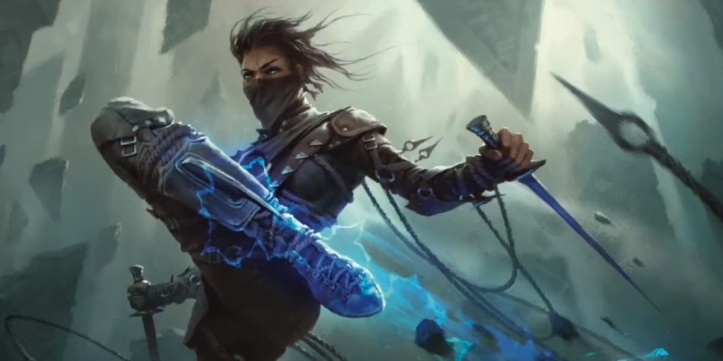
The Blade Singer is one of D&D 5e‘s earliest attempts at a gish (although later than the Eldritch Knight), from the Sword Coast Adventurer’s Guide.
The initial attempt at a Bladesinger Wizard gish subclass in D&D 5e was good but missed the mark. It suffered from design that made it much more of a high-Armor Class Wizard than a good melee fighter.
However, the Bladesinger Wizard’s altered reprint in Tasha’s Cauldron of Everything catapults it well ahead of much of the competition.
The Tasha’s Cauldron of Everything Bladesinger Wizard in D&D 5e gives the subclass more teeth and does more to encourage getting stuck in than the original version.
Its defensive qualities remain as effective as ever. With high Dexterity and Intelligence, a D&D 5e Bladesinger Wizard can become almost untouchable. Similarly, its buff to Concentration saving throws makes taking damage less risky for D&D 5e‘s best spells.
Where the reprinted Bladesinger shines is its offensive capabilities. It can replace one of its weapon attacks with a cantrip. When dual-wielding, a D&D 5e Bladesinger Wizard can attack three times in one turn, with one getting the full benefit of Booming Blade or Green-Flame Blade. It’s almost an unfairly better version of the similar Eldritch Knight feature.
This sheer buff does encourage a Bladesinger to wade into melee rather than hanging around the back with better Armor Class, particularly for players seeking the gish playstyle. The d6 hit die is a drawback, but it’s necessary to stop the Bladesinger from being the best D&D 5e gish subclass with no drawbacks.
The Hexblade Warlock Blends Magic and Swordplay Perfectly

Now, on both this blog and the wider D&D 5e community as a whole, the Hexblade is the target of mockery, both good-natured and a little bit cruel.
Much of this centres on just how good the D&D 5e Hexblade Warlock is for multiclass builds. Just one dip in Hexblade lets people use Charisma as their attacking stat for one-handed melee weapons, gives them a once per short rest Curse for extra damage and beefy crits, access to spells like Hex and Shield, and a spell slot that refreshes on a short rest.
In short, it’s good for Sorcerers, Bards, Paladins, and probably a variety of other classes as well. It’s gotten to the point where a common piece of advice in D&D 5e optimisation discussions (and go-to punchline about those discussions) is “Have you considered a one-level Hexblade dip?”
Obviously, there’s a failure in design in just how good the D&D 5e Hexblade is with one single level of multiclassing. Another failure of design is that the Hexblade, due to the extra damage given by Hexblade’s Curse, happens to be able to outdamage any other Warlock class just by using Eldritch Blast. But when you play a Hexblade as a gish, without blasting and without multiclassing, it’s actually a great experience.
It’s not just the spells. In fact, due to D&D 5e‘s lopsided adventuring days, a Warlock doesn’t always get a lot of those per day. The Hexblade is just dripping magical abilities and able to mix it up nicely in melee.
The Hexblade in D&D 5e can summon a weapon to its hand, change appearance at will, use magic to drag its enemies closer and stop them running, summon a powerful demon to flank their enemies, and smite a dragon out of the sky. All of this comes from a mixture of spells, Eldritch Invocations, and innate class abilities.
This is with more hit points than the D&D 5e Bladesinger Wizard, a better balance of magic and melee than most subclasses on this list, and without a mandatory pet like the Battle Smith. If you want a perfect, single-classed gish build in D&D 5e, the Hexblade is your dream subclass.
So, there you have it. Five of the best gish subclasses in D&D 5e if you want to mix magic and martial arts, sling swords and spells, and otherwise gish it up. I would love to hear about your own D&D 5e gish builds. Otherwise, please do like this article, share it around, and read some of my other work. Thank you!
For more holistic tips on character creation, check out ‘How to Come Up with D&D Character Ideas‘.
If you’re happy to blend Divine magic and martial might, then ‘The Best Ranger Races and Lineages in D&D 5e‘ might be the article for you.
 Artificial Twenty
Bladesinger is, IMO, better than Hexblade (especially with Green Flame Blade and Booming Blade)
LikeLike
Definitely a valid take! Following Tasha’s (which, I believe, the first version of this article predates), the Bladesinger is a monster. The Eldritch Knight wept.
I think the Hexblade more than stands its ground, between Single Ability Dependency, deceptively powerful defense, and the freedom of weapons it has (with Pact of the Blade). Bladesinger’s awesome, but a little restricted in some ways.
Just my take, though, and yours is definitely defensible.
LikeLike