Dungeons & Dragons Fifth Edition has done a lot for the D&D brand and the entire TTRPG space. It’s one of a number of factors that, along with the mainstreaming of geek culture, exposure in Stranger Things, Community, and Critical Role, has led to the entire medium having a resurgence.
That said, D&D 5e isn’t a perfect system. Far from it.
Having been blogging about it for a long time, I’m not going to turn around and say that D&D 5e is terrible, bad, or even simply not good. With plenty of experience in it and other systems, it’s still one of my favourites.
At the same time, D&D 5e does have its flaws, from minor issues to large, systemic problems throughout the system. Every TTRPG does. The best way to combat D&D 5e‘s is to know what they are, and either accept or account for them – and hope they fix it in the 2024 D&D 5e update.
Imbalanced Player Options and Power Creep
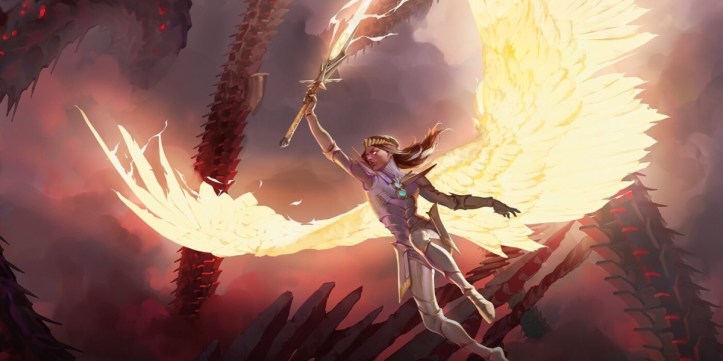
I want to put a significant disclaimer here. D&D 5e is far from the worst-balanced version of Dungeons & Dragons. It could print a lore-accurate ‘Jesus’ class and still have better balance than D&D 3.5.
At the same time, D&D 5e is not perfectly balanced.
This is clear from the main divide between classes. Spellcasting is so versatile and powerful that it opens many doors martial characters cannot dream of touching. A party of all spellcasters can get by with the right builds and creativity. A party of martials doesn’t have the options for either.
This also applies between the D&D 5e classes themselves. Monk and Ranger are infamous for their weak core chassis and situational features. Conversely, the D&D 5e Paladin is well-equipped to be top-tier in almost any aspect of the game, and it’s still vying for top spot with Wizard, Bard, and Druid.
Going even further, many D&D 5e classes have subclasses that are dramatically weaker or stronger than others. The D&D 5e Champion and Banneret Fighters are almost useless compared to the Battle Master or Echo Knight. A Thief Rogue has nothing on a Phantom.
In many cases, these imbalanced D&D 5e subclasses are due to power creep. Rarely does a new D&D 5e book come out without better options than what is already available.
Sorcerer subclasses are the most infamous example of D&D 5e power creep. The Aberrant Mind and Clockwork Soul from Tasha’s Cauldron of Everything are so much better than any other option because of their vast and flexible bonus spell lists.
It isn’t that older D&D 5e classes and subclasses are worthless, or that the game has spiralled out of control. Nonetheless, uneven balance, caused partly by power creep, is one of D&D 5e’s biggest weaknesses.
A Far Too Long Adventuring Day
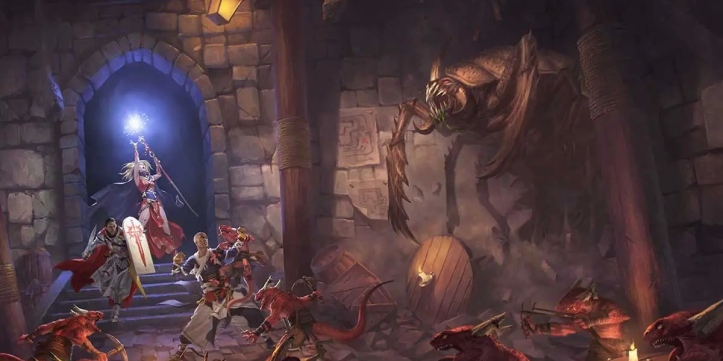
Now, many of D&D 5e‘s common issues in play come from how tables and DMs run the game. When almost every table runs it the same way that goes contrary to the rules, however, it’s not every D&D 5e table that is in the wrong.
D&D 5e is designed around an adventuring day with 6-8 combat encounters, separated by two short rests. This is the platonic ideal of the system, at which point its combat and classes are theoretically balanced and well-challenged.
I don’t know anybody who routinely hits this. I think many tables suffer because the DM refuses to put more than one combat in at a time, but there has to be a middle ground.
Apart from anything else, 6-8 encounters take a long time. D&D 5e combat is rarely swift, even when everyone is at the top of their game. Most players don’t want an adventuring day to take three grindy sessions of violence.
It also results in most combats becoming tedious. D&D 5e fights don’t need to all be death-or-glory challenges that push players to their limits. However, there’s little fun in a random, incidental encounter that poses no threat and only exists to drain spell slots.
This also results in D&D 5e‘s CR system being almost meaningless, given it’s built according to these guidelines. Compared to other systems, such as Pathfinder 2e or D&D 4e, it’s very unhelpful as a guideline.
I think D&D 5e would be far better off if it aimed for 2-3 or 3-4 combat encounters in a day, upping the difficulty of each. Given the structure of most official D&D 5e campaigns, the designers agree.
Feats and Multiclassing Are Incredibly Wonky

D&D 5e‘s limited character customisation isn’t necessarily a weakness. It’s simply a difference of style from other TTRPGs.
However, it’s a significant weakness of D&D 5e that the two main ways to customise characters after creation, feats and multiclassing, are both uneven and poorly thought-out.
Feats are vastly expensive, costing one of a character’s limited Ability Score Improvements for their benefits. At the same time, there’s almost no internal balancing between D&D 5e feats.
Some, like Sharpshooter or War Caster, are game-changing and almost essential for the best builds in D&D 5e. Others, like Athlete or Dual Wielder, are bundles of benefits that are rarely worth it. Some, like Grappler, are almost worthless.
If you get a feat in D&D 5e, it will almost always be one of the top tier. The rest are close to wasted paper. Furthermore, there’s a significant imbalance between D&D 5e characters who have taken the best feats and those who haven’t.
It’s a further weakness of D&D 5e that multiclassing isn’t any better. It’s easy to ruin a character with D&D 5e multiclassing, and not too difficult to break the game’s balance.
Almost everybody knows the power of the infamous Hexblade Warlock multiclass in D&D 5e. Even aside from that, interacting with the system needs players to either plan out a synergistic build that ignores D&D 5e balance, or risk inadvertently making their character worse.
Strictly speaking, both multiclassing and feats are optional in D&D 5e. However, it feels like being optional is used as an excuse to not balance them. Alternatively, the designers realised how imbalanced they were and labelled them as optional after the fact.
Magic Weapons in D&D 5e Really Are Necessary
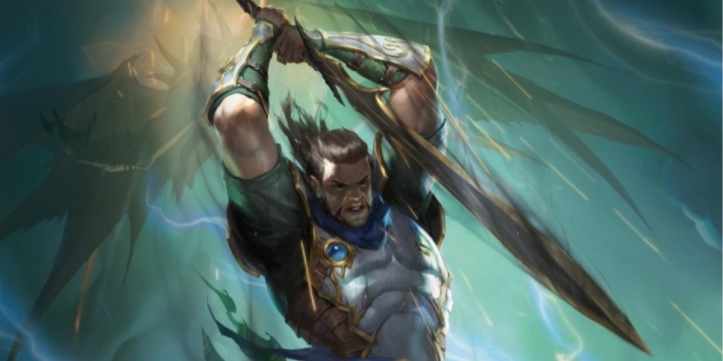
After the ‘magic weapon treadmill’ of D&D 3.5 and the in-book magic item costs of D&D 4e, D&D 5e has made magic items a significantly less vital part of the system.
Officially, D&D 5e claims that magic items aren’t necessary and that the game functions without them. As a result, it only gives loose guidelines in a handful of books for giving out magic items.
The problem is that, for many D&D 5e classes, the game is almost unplayable without magic weaponry, at the very least. Most enemies past a certain CR have a built-in resistance or immunity to non-magical damage.
Given that damage is one of the few areas D&D 5e martials excel in, this is a problem. Furthermore, the solutions often rely on allies casting very specific buff spells. Alternatively, they involve everyone having at least a magic sword.
Lacking one in high-level D&D 5e is effectively waiting to be allowed to play, either by the Dungeon Master or other players. Despite this, the game tries to insist that they’re a nonessential part of play and that the damage resistances are an important part of balancing.
I don’t necessarily want D&D 5e to go for a Pathfinder style where the game is built around a certain amount of magic items at every step of the game, but there has to be a balance to avoid this weakness of D&D 5e.
High-Level Play Remains Impractical
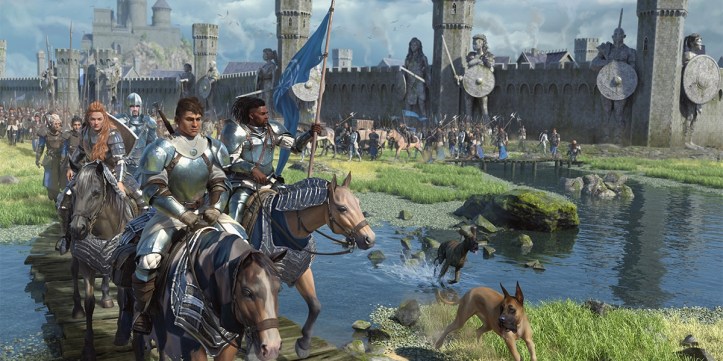
Very few campaigns reach high level in D&D 5e. Vecna: Eve of Ruin is one of a handful to try, and it remains to be seen how well it manages this.
This is because high-level D&D 5e gameplay loses the relatively grounded and playable nature of the early game. Instead, most of the system’s problems worsen and the entire thing risks falling apart.
High-level characters in D&D 5e, particularly spellcasters, have too many options that are entirely capable of breaking the game. Campaigns like Waterdeep: Dungeon of the Mad Mage acknowledge this by restricting teleportation, planar travel, and more.
It’s difficult to create a challenge for a high-level party that can’t be trivialised. Likewise, it’s rare to make an effective high-level D&D 5e combat that doesn’t rely on shutting down players’ hard-earned options.
Forcecage, Wish, Planeshift, and more all make high-level D&D 5e impractical and swingy. It also furthers the divide between classes. Past level 10, spellcasters begin to rewrite the fundamentals of reality. Martials hit more often.
There is some genuinely entertaining content in the system for the late game. At the same time, it’s an infamous weakness of D&D 5e that it plays much better for the first ten systems than it does the last ten. Other TTRPGs manage.
Uninspiring Monster Design, Especially In Early Books

D&D 5e has many books of enemies, ranging from the Monster Manual to Mordenkainen Presents: Monsters of the Multiverse. There are hundreds for a DM to choose from, able to populate many different environments.
At the same time, variety is lacking.
Most D&D 5e monsters are bags of hitpoints with a melee multiattack. They differ in description, ability scores, Armor Class, and health, but all occupy a similar role. They take hits, they close in, they do a bit of damage, they die.
This isn’t to say D&D 5e has hundreds of identical monsters. There are important variations in saving throws, ranged attacks, movement types, and more. But they can still feel repetitive.
Similarly, there are genuinely outstanding monsters in D&D 5e, particularly in later books. For every multiattacking Owlbear knock-off, you have a psionic Mind Flayer, imprisoning Astral Dreadnaught, or truly epic Mythic Monster.
Even in more interesting D&D 5e monster designs, there’s a tendency to use spellcasting as a substitute for original abilities. This is a tendency that Mordenkainen Presents: Monsters of the Multiverse does try to avert, to mixed results.
This is especially a blow after the monster and encounter design of D&D 4e, which is one of the few un-controversial aspects of that system. It’s been celebrated for its enemy variety and ease of contrasting different roles together.
Monster design isn’t universally bad in D&D 5e, but the system is flawed due to its reliance on many similar, non-distinctive enemy designs.
These have been six of D&D 5e‘s biggest flaws as a system. None of these are dealbreakers, but they are things that a DM either has to work to overcome or learn to accept. May the designers learn from them going forward.
Please do leave this article a like, share it with your friends, and check out some more Artificial Twenty content. Thank you!
For more insights into the weaknesses of TTRPG systems, check out ‘Six Flaws of Critical Role’s Daggerheart Playtest‘. Likewise, none of its problems are damning.
For a little more positivity about TTRPGs, check out ‘The Best TTRPG Actual Play Series and Podcasts‘ for more of a celebration of creativity.

